Remote Online Notarization: The Last Analog Step in Digital Transformation


A prenup platform lets two people build and sign an agreement online, then tells them to print it, leave the house, and track down a notary willing to meet in person.
An equipment finance company sends customers off to locate a notary and schedule a visit, a step that regularly added one to two weeks to the timeline.
A healthcare records company handles millions of medical records for insurers, then turns away the requests that need a notarized affidavit because it has no way to produce one.
Three companies with nothing in common…except a major gap.
Look at enough of them and the shape stops reading like coincidence. A business digitizes its workflow end to end, and exactly one step survives the transition: the moment a signature has to be witnessed by someone with legal standing to say it happened. That step is still a printer, a car ride, and a stranger's office during business hours.
Key takeaways
- The gap is structural. Notarization is the one step that asks software to establish a fact about a person rather than move information around. It got carved out of digital workflows because software couldn't do it, and it stayed carved out for a decade after that stopped being true.
- It survives because it belongs to nobody and breaks nothing. The step sits at the boundary between your product and the physical world, and it registers as a cost of doing business rather than a defect, so it never reaches a roadmap.
- The real cost hides in completion rate. HelloPrenup was losing roughly one in five notary sessions to mid-meeting disconnects, now under 4%. Leasepath runs 99.15%, Sherpas Healthcare 100%. A session that starts and fails costs more than one that never started.
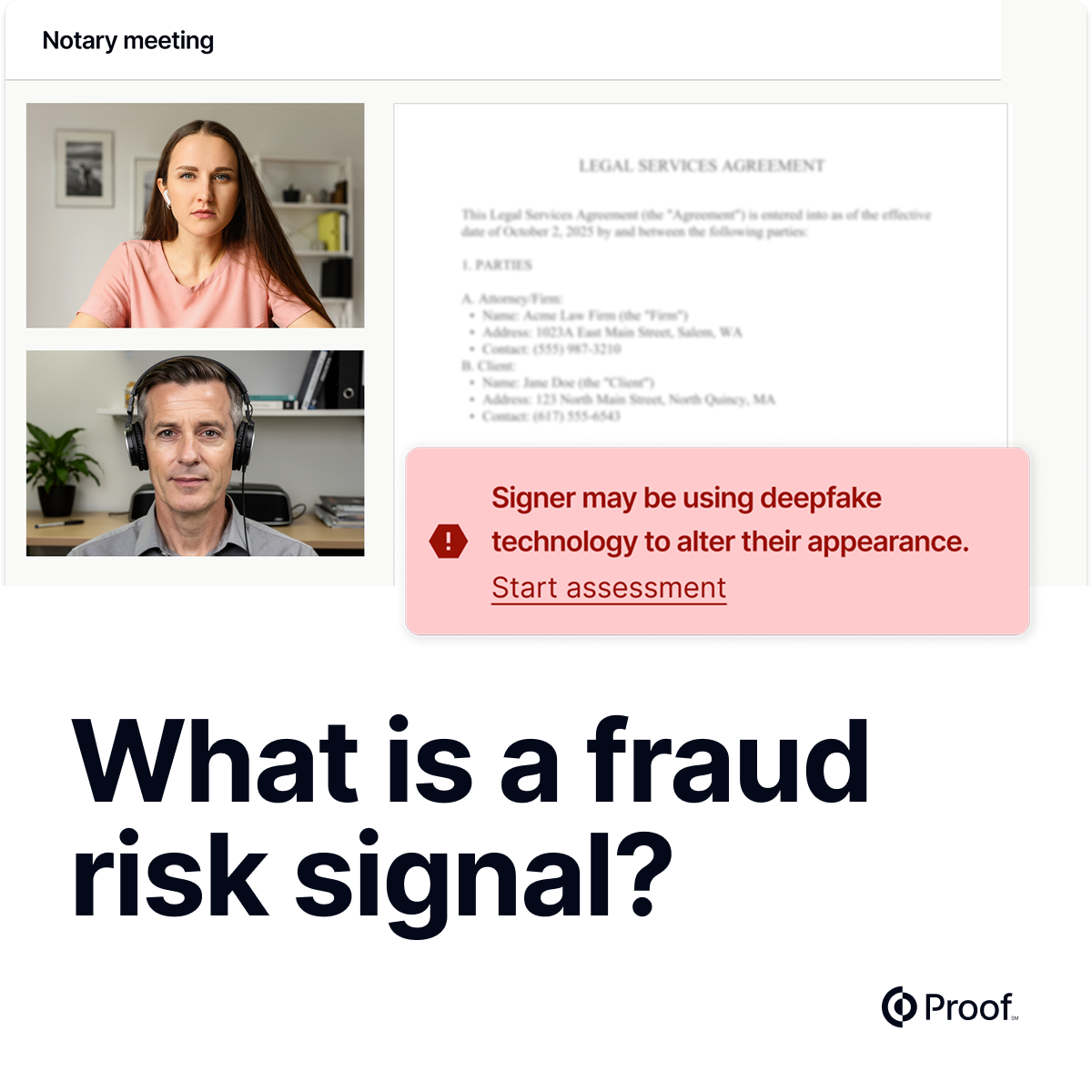
- Identity verification over video is a solved problem. Knowledge-based authentication, credential analysis, live notary verification, biometric selfie fallback, continuous deepfake scoring, and a complete audit trail. The digital record is stronger than the stamp and logbook it replaces.
The step that got carved out
There's a reason it's always this step, and it's more interesting than "nobody got around to it."
Every other step in a business workflow moves information from one place to another. An application, a credit decision, a generated document, an electronic signature. Software has always been good at all of it. Notarization asks for something categorically different: establish a fact about a human being, that this person is who they claim to be and they meant to do this, then stake a legal record on it.
For most of software's history, that wasn't something software could do. So the step got carved out of the workflow and handed to a human with a stamp, and everything around it got optimized instead. The carve-out was correct when it was made. It has also outlived its reason by roughly a decade, and it's still sitting in workflows that have otherwise been rebuilt twice.
Mortgage is the one industry that measures the gap closely enough to size it. As of July 2026, about 13% of loans registered on the MERS System also had an associated eNote registration. Fannie Mae's 2025 lender survey found 75% of lenders are familiar with eNotes while 22% have adopted them. In title production, 27% of professionals still have to obtain records in person, which ALTA notes adds "time, cost, and potential delays".
Every other industry has the same gap…mortgage is just the one that counts it.
Why nobody fixes it
Two things keep this step alive long past the point anyone would defend it on the merits:
- It sits at the boundary of the process. The customer leaves your product, does something in the physical world, and comes back. From inside an org chart, that middle part belongs to someone else, which is a reliable way of saying it belongs to nobody.
- It doesn't register as a defect. Nothing breaks. The deal closes, the document gets signed, the lease funds. It simply takes longer and costs more than it needs to, spread across enough transactions that no single one is worth escalating. A step like that reads as a cost of doing business rather than a problem, so it never makes a roadmap.
This is how a company ends up carrying a two-week delay nobody has ever put a number on.
The cost shows up where people aren't looking
The obvious win from closing this gap is speed, and the speed numbers are real for our customers:
- AP Equipment Financing's notarization step "regularly added one to two weeks to the timeline," and now runs about 2.5 minutes on average across more than eight thousand transactions.
- Column's affidavits of publication went from a process measured in days to an average of 7 minutes, across 11,800 notarized transactions since 2022.
- Preferred Title was overnighting documents to out-of-state sellers and overnighting them back, a round trip that now takes under 30 hours from send to signed.
The numbers that hit a business hardest, though, are completion rates.
HelloPrenup had notary sessions disconnecting in roughly one out of every five meetings. Each disconnect meant the signer had to reauthenticate and start over, at a moment couples had already worked up the nerve to get through once. That rate is now under 4%. Similarly, Leasepath recorded a 99.15% completion rate in 2025. And Sherpas Healthcare Solutions has held 100% since starting on the platform, in a business that had previously been turning away requests it couldn't serve at all.
A session that starts and fails costs more than one that never started, because the customer already decided and already showed up before something in your process sent them away. Most teams don't measure that number. It's usually the one that would have justified the project two years earlier.
Sherpas Healthcare Solutions is the sharpest version of this. Their technicians work on-site at facilities across the country, and when a request needed a notarized affidavit, the company had no way to produce one. As team member Taylor Cuellar put it: "A lot of facilities want a one-stop shop, and if we can't provide notarization, they're happy to look elsewhere." A missing step that slows revenue down is an operations issue, and one that caps how much work you can accept is a ceiling on the business.
What changed on the other side
The reason this gap is closable now, and wasn't in 2010, is that the hard part got solved. Establishing who someone is over a video connection turned into an engineering problem with an answer.
During a Proof notarization, signer identity is verified through knowledge-based authentication, credential analysis, and live notary verification. A signer who can't complete KBA, typically because they don't have a U.S. Social Security number, can instead take a biometric selfie compared in real time against their government-issued ID.
For the compliance reviewer who will inevitably ask, the session produces an audit trail containing signer names and emails, signature timestamps, physical locations during notarization, ID verification outcomes, KBA results, and the application of signatures, initials, seals, and digital certificates. The audio and video recording of the meeting, including the chat transcript, stays with the transaction record.
Column's team pointed at exactly this benefit when explaining why the integration survived scrutiny from courts, agencies, and law firms: "Every notarization now includes verified identity, an audit trail, and a digital seal that cannot be altered."
How to tell if you’re analog steps have hidden costs
If you regularly encounter one of these challenges, analog steps are at best disrupting your workflow - and at worst, costing you business.
Your customer has to leave the screen. Somewhere in your flow, does a person have to print something, mail something, drive somewhere, or find a stranger with a stamp?
Sessions start and don't finish. Abandoned or failed verification sessions are the most under-instrumented metric in most customer-facing workflows, and they're where this cost actually lives.
You're losing work you could otherwise do. Sherpas Healthcare Solutions was turning down chart audit requests. Preferred Title was watching customers question whether their own paperwork was legitimate. When a missing capability shows up in your win/loss notes, it stopped being an operations problem a while ago.
Every customer mentioned in this blog had already done the hard part. The platform worked, the workflow was built, the customer was ready and willing. What remained was one step that sent someone to a printer, a post office, or a stranger's office during business hours.
Digital transformation isn’t complete until the experience is seamless for your customer. To learn more about the hidden costs within analog steps (and to learn how to close those digital gaps), check out our field report >


























.jpg)


















































.jpg)