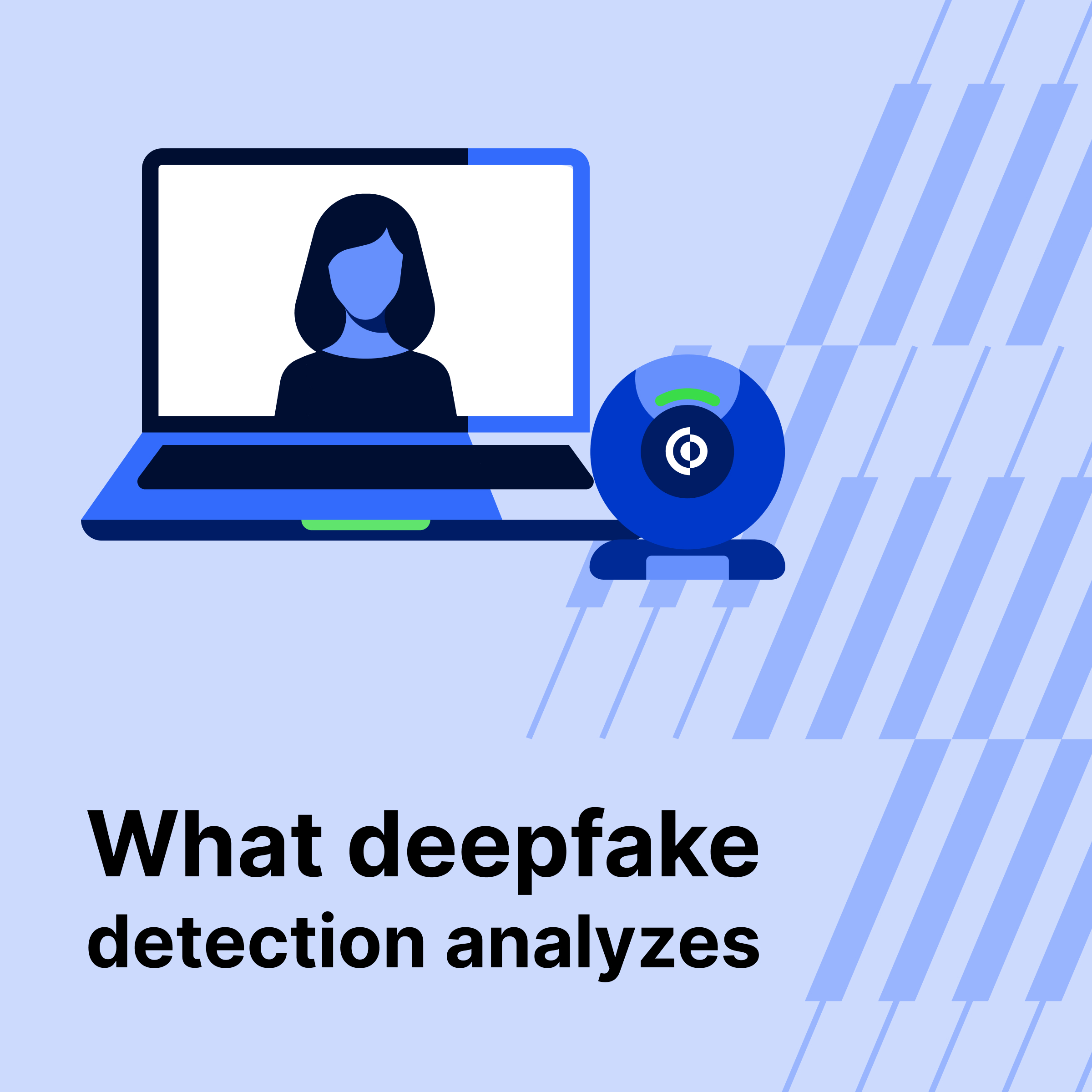
What Deepfake Detection Actually Analyzes in a Candidate Video

Updated October 8, 2026
The question HR leaders ask most often after seeing deepfake detection in action: "But how does it actually know?" Most vendors respond with an accuracy rate, and that matters. But a rate tells you how a model performed against known attacks. What happens when attack techniques evolve?
Let’s talk about what Proof assesses, and why those risk signals are so important for detecting fraudulent candidates.
Key takeaways
- Deepfake detection and pre-recorded video detection are different problems. Different attack types produce different signals, and a system built to catch one may miss the other entirely.
- The visual artifacts that once made deepfakes easy to catch have largely been addressed by generative AI. Detection has had to evolve beyond face analysis.
- Effective deepfake detection in hiring operates on three signal categories: visual artifacts, behavioral patterns, and network context. Systems that analyze only one of these categories are incomplete.
- Proof's detection model is informed by over 600,000 hours of video data across financial services, real estate, notarization, and hiring, giving it exposure to fraud patterns that hiring-specific tools rarely see.
Why "does this look real?" is the wrong question for deepfake detection
The intuitive model of deepfake detection is that a system looks at a face, decides whether it appears generated, and flags it if so. That intuition made sense a few years ago, when generated faces had obvious artifacts: unnatural blinking, lighting that did not match the background, faces that blurred at the hairline.
Generative AI has largely addressed those problems. The faces coming out of current generation tools are visually convincing enough that surface-level analysis of the face is no longer a reliable signal on its own. A detection system built primarily around spotting visual artifacts is playing catch-up to a generation problem that has already moved past it.
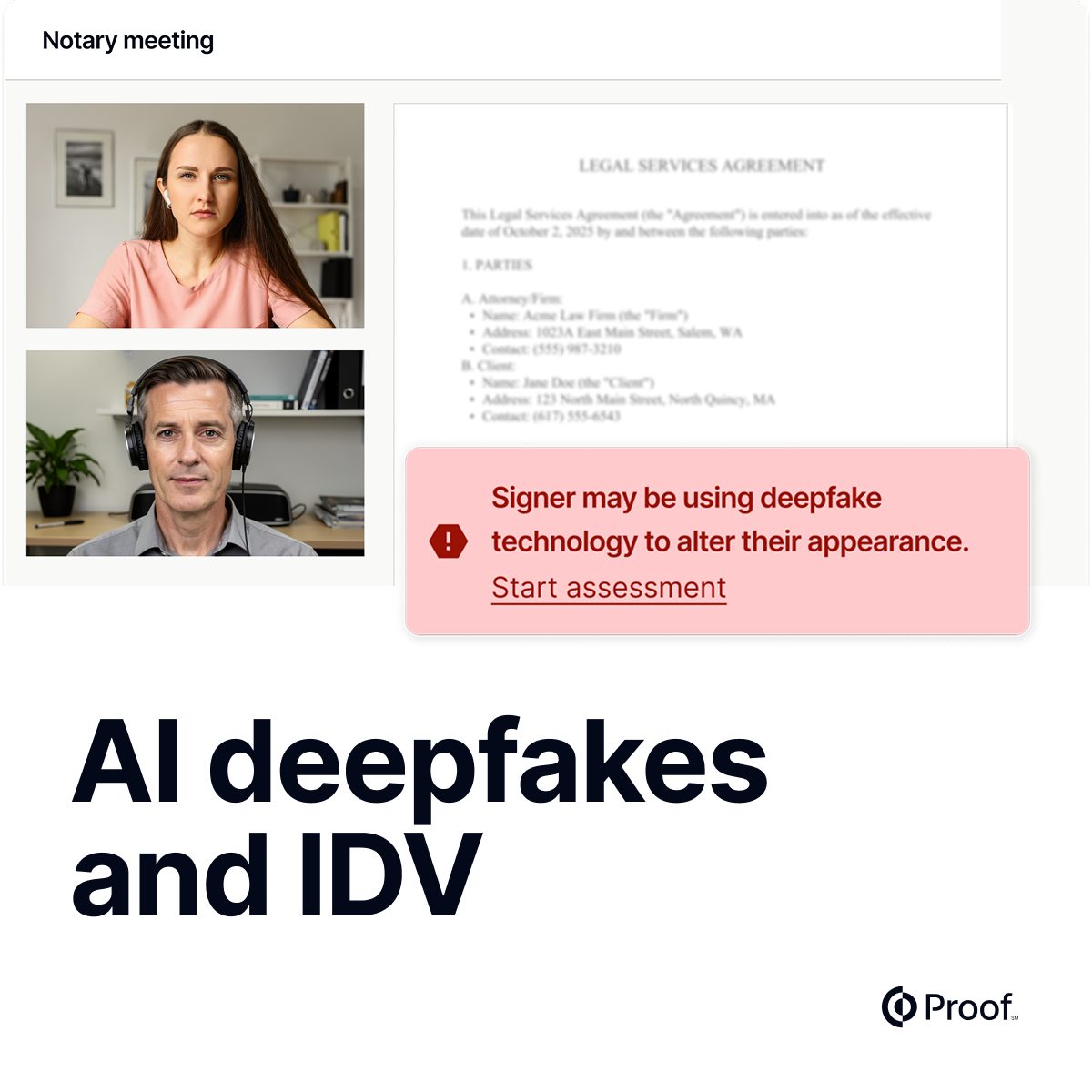
The harder problem, and the one that actually matters for hiring fraud specifically, is distinguishing between a real person on camera and a synthetic video stream being routed into a session. Those are different attacks with different signatures. A system built to catch one may not catch the other. Detection has to operate on a broader set of signals than visual realism alone.
What deepfake detection actually looks at in a hiring video
Visual signals are one input, not the whole picture. There are still artifacts that generative AI produces that differ from the physics of a real camera capturing a real face: inconsistencies in how light behaves across the video, patterns in how the image renders across frames that a trained system catches before any human reviewer would notice something wrong.
Those signals matter. They are just not the only thing we are looking at.
Behavioral signals matter too. Real people interact with a camera in ways that are difficult to replicate convincingly at scale. The relationship between what someone says and what their face does, the way gaze moves, the inconsistencies that emerge when a synthetic stream has to stay coherent across a real-time session. These generate signals that go beyond whether the face looks generated.
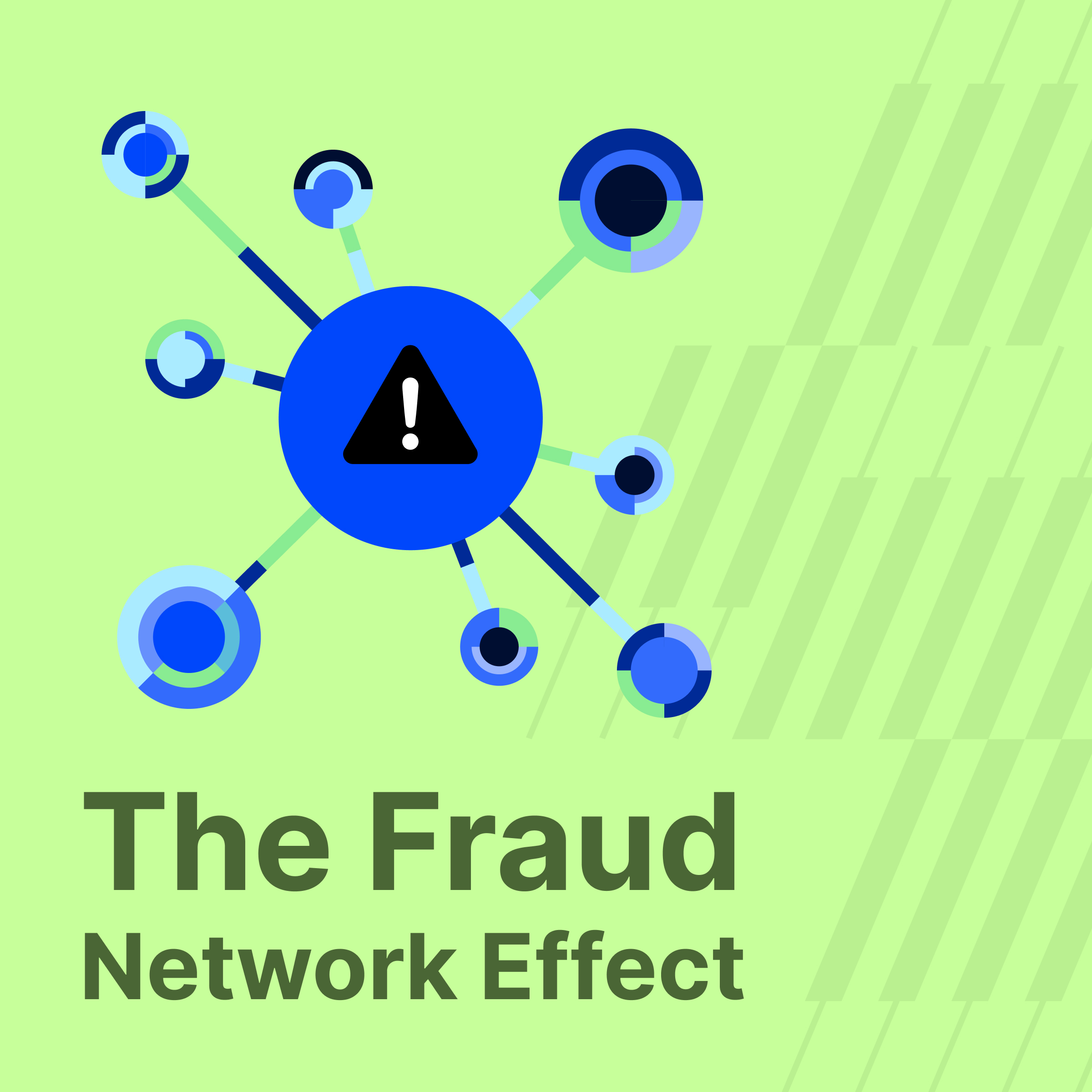
And then there is network context. Proof processes hundreds of billions of dollars in authorized transactions across real estate, financial services, notarization, and hiring. A fraud pattern that surfaces in a financial services session can inform detection in a hiring pipeline. That breadth of signal is something a point solution built specifically for hiring IDV does not have access to. The detection problem is more tractable when the model has seen fraud across more of its forms.
How deepfake detection stays current as AI gets better
Generative AI is improving. The techniques that produce convincing synthetic video today are not the same as the techniques from two years ago, and they will not be the same two years from now. A model trained on a fixed dataset, certified at a point in time, and deployed without ongoing retraining will drift. The fraud it was built to catch will become a smaller share of the fraud it actually sees.
Our model is informed by over 600K hours of video data. And that number keeps growing. When a Proof agent reviews a session and flags something as suspicious, that signal feeds back into the model. When new generation techniques appear, we are seeing them across the breadth of Proof's transaction network before most hiring-specific tools would have enough examples to train on. The detection has to be continuous because the problem is continuous.
What this means when you're evaluating deepfake detection for your hiring process
Deepfake detection that works is not a feature you configure once. It is a system that stays current. The vendors worth evaluating are the ones who can answer, specifically, how their model trains on new data, what the feedback loop looks like when a detection fails, and what share of their training signal comes from hiring-specific fraud versus adjacent verticals where fraud patterns often appear first.
A liveness certification from six months ago tells you the system met a threshold at a point in time. It does not tell you whether the attacks showing up in your pipeline today were in the training data when that certification was issued.
The hiring teams that are best protected are the ones whose vendor can explain, clearly and specifically, what they are looking at and how they stay current. That conversation is worth having before you deploy, not after. See how Proof Defend approaches detection across the hiring funnel >














































.jpg)


















































.jpg)