Electronic Signatures vs. Digital Signatures: What's the Difference?

Updated July 8, 2026
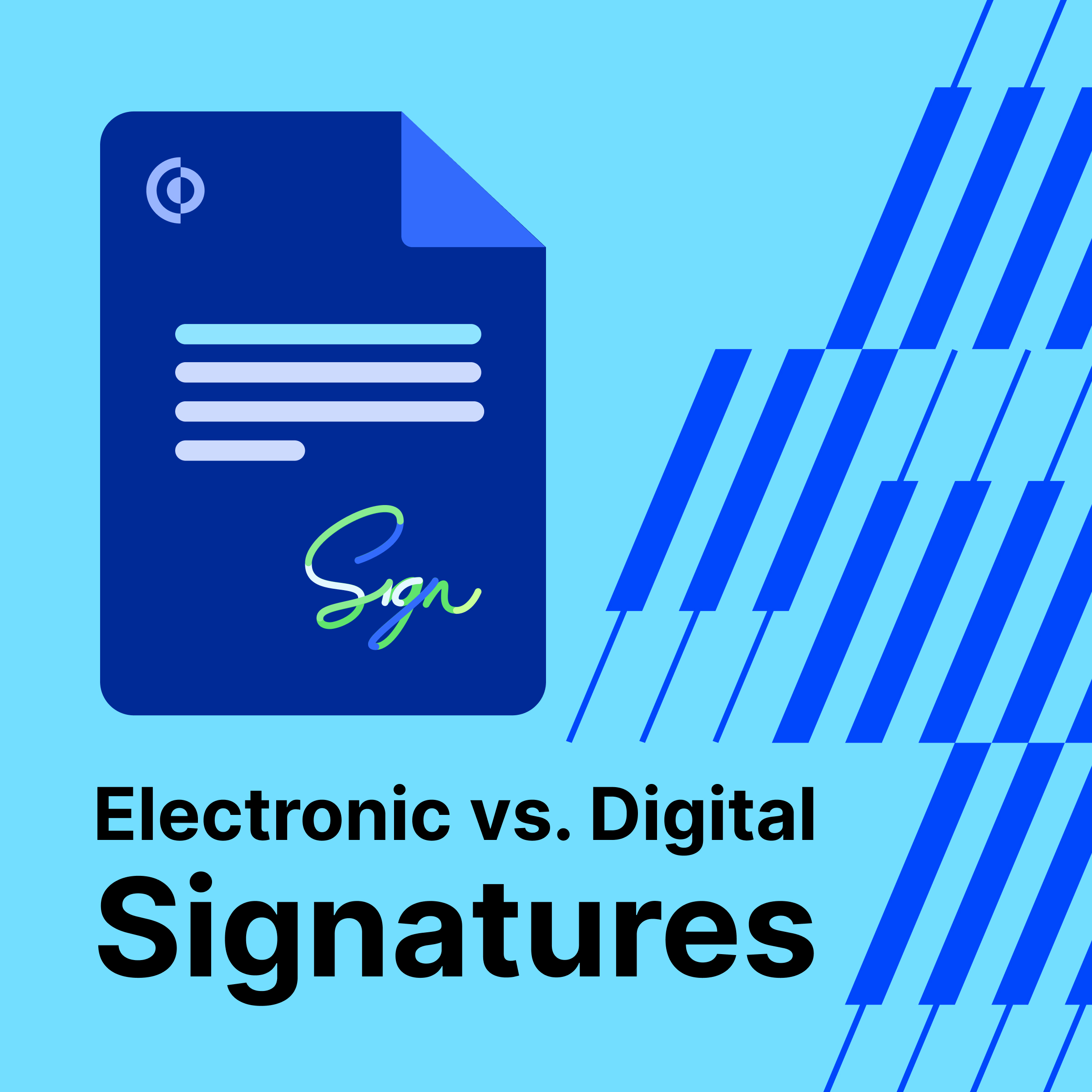
The terms get used interchangeably, but they describe fundamentally different things. An electronic signature is any electronic representation of a person's intent to sign.
A digital signature is a specific cryptographic technology that verifies the signer's identity and proves the document hasn't been altered since signing. Every digital signature is an electronic signature.
The reverse is not true.
For most casual use cases, the distinction doesn't matter much. For regulated industries, high-value contracts, or anything that might end up in litigation, it matters a lot.
Key takeaways
- An electronic signature (e-signature) captures intent to sign — it can be as simple as a typed name or a checkbox click, but it does not inherently verify who signed or whether the document was altered afterward.
- A digital signature uses Public Key Infrastructure (PKI) cryptography to mathematically bind the signer's verified identity to the document, making any post-signature tampering immediately detectable.
- Every digital signature is a type of electronic signature, but not every electronic signature is a digital signature — the distinction matters significantly in regulated, high-value, or litigation-sensitive workflows.
- Digital signatures provide two properties basic e-signatures cannot: tamper-evidence (the signature invalidates if the document changes) and non-repudiation (the signer cannot credibly deny signing).
What Is an electronic signature?
An electronic signature (also called an e-signature) is broadly defined under US law as "an electronic sound, symbol, or process, attached to or logically associated with a contract or record and executed or adopted by a person with the intent to sign." That's the language from the federal ESIGN Act (2000), which gave e-signatures the same legal standing as handwritten signatures for most transactions.
In practice, an electronic signature can be as simple as:
- Typing your name into a form field
- Clicking "I agree"
- Drawing your signature with a mouse or stylus
- A scanned image of your handwritten signature
The ESIGN Act and the Uniform Electronic Transactions Act (UETA), adopted by 49 states and DC, provide the legal foundation. E-signatures are valid and enforceable for most contracts under these laws.
What e-signatures don't inherently provide: authentication of the signer's identity, proof that the document hasn't been changed after signing, or a verifiable audit trail that would satisfy a skeptical court. A typed name in a box doesn't prove who typed it.
What Is a digital signature?
A digital signature is a type of electronic signature that uses Public Key Infrastructure (PKI) cryptography to accomplish two things basic e-signatures can't: verify the signer's identity and detect any post-signature tampering.
Here's how it works at a high level:
- A Certificate Authority (CA) issues the signer a digital certificate that contains their public key and verified identity information.
- When the document is signed, a mathematical algorithm generates a unique "hash" of the document's contents.
- That hash is encrypted with the signer's private key, creating the digital signature.
- Anyone with access to the signer's public key can verify the signature and confirm that the document content matches the hash, meaning nothing was changed after signing.
If even a single character in the document is altered after signing, the hash will no longer match and the signature will be flagged as invalid. This property is called tamper-evidence.
The other key property digital signatures provide is non-repudiation: the signer cannot credibly claim they didn't sign the document, because the cryptographic binding between their identity and the document is mathematically verifiable.
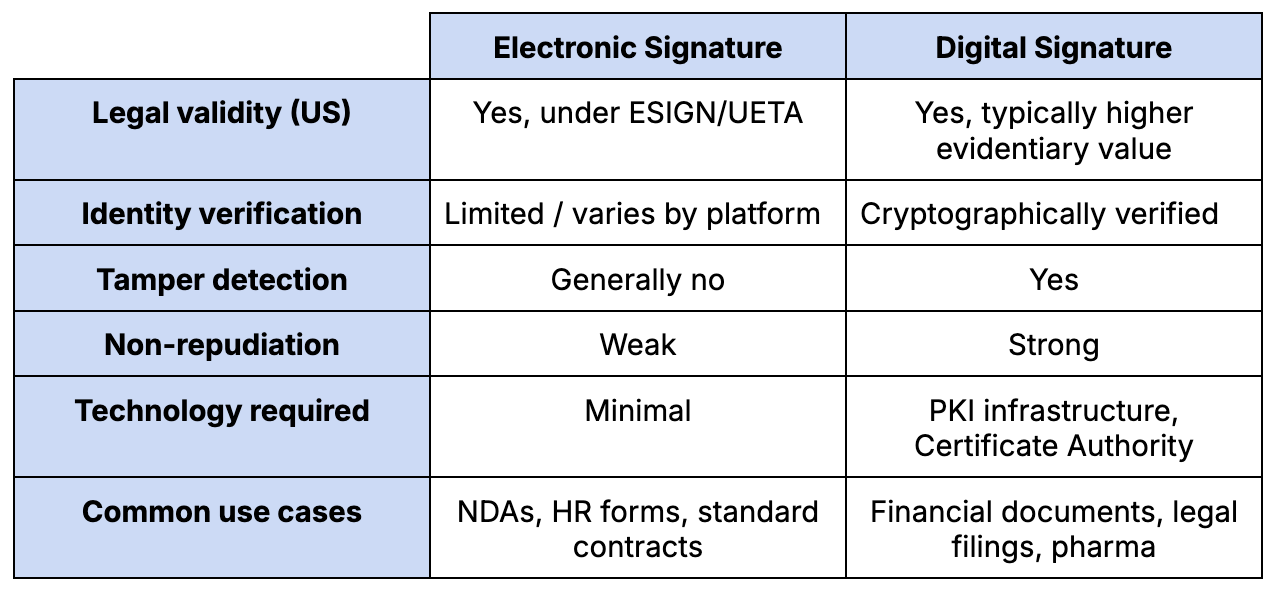
Comparing the two
What the law requires, and when
In the US, the ESIGN Act and UETA are permissive: they validate e-signatures broadly without mandating any particular technology. Most commercial agreements are fine with a basic electronic signature.
However, several industries and document types either require or strongly benefit from digital signatures:
- Financial services: Loan documents, securities transfers, and certain investment agreements are subject to regulatory scrutiny that makes the stronger audit trail of digital signatures valuable. The SEC and FINRA have both issued guidance reflecting this.
- Healthcare: HIPAA doesn't mandate digital signatures, but it does require that electronic records be protected against unauthorized alteration, which the tamper-detection properties of digital signatures directly address.
- Government contracts: Many federal and state government agencies require digital signatures for procurement, particularly for contracts involving sensitive data or national security.
- International transactions: The EU's eIDAS Regulation creates a hierarchy of electronic signature types. A Qualified Electronic Signature (QES), which is the highest tier of digital signature, is given the same legal weight as a handwritten signature and is required for certain regulated EU transactions.
- Pharmaceutical and clinical trials: FDA 21 CFR Part 11 governs electronic records and signatures in clinical research, effectively requiring digital signatures with audit trails for regulated data.
What about notarized signatures?
There's a third category worth noting: notarized signatures. A notarized signature (whether in-person or via remote online notarization) is an electronic or handwritten signature that has been verified by a commissioned notary. The notary confirms the signer's identity in real time, administers an oath if required, and applies their official seal.
A notarized digital signature combines the highest levels of both identity assurance and document integrity. For documents that may be contested in court, executed in regulated transactions, or required by specific institutions, notarization adds a layer of legal authority that neither a basic e-signature nor a standalone digital signature provides on its own.
This matters particularly for real estate closings, powers of attorney, affidavits, and financial account transfers where the accepting institution specifically requires notarization.
A common misconception
Many platforms market their services as offering "digital signatures" when they're technically offering basic electronic signatures with an audit log. That's not necessarily a problem for everyday use, but it matters when the legal bar is higher. If you're relying on a signature for regulatory compliance or litigation readiness, verify what your platform actually provides, specifically whether it uses PKI cryptography and a Certificate Authority.
The audit trail a compliant platform creates matters too. Timestamps, IP addresses, identity verification steps, and a tamper-evident seal are what allow a signature to hold up under scrutiny.
Proof supports electronic signatures, identity-verified signatures, and fully notarized documents, depending on what your workflow requires.
































.jpg)


















































.jpg)