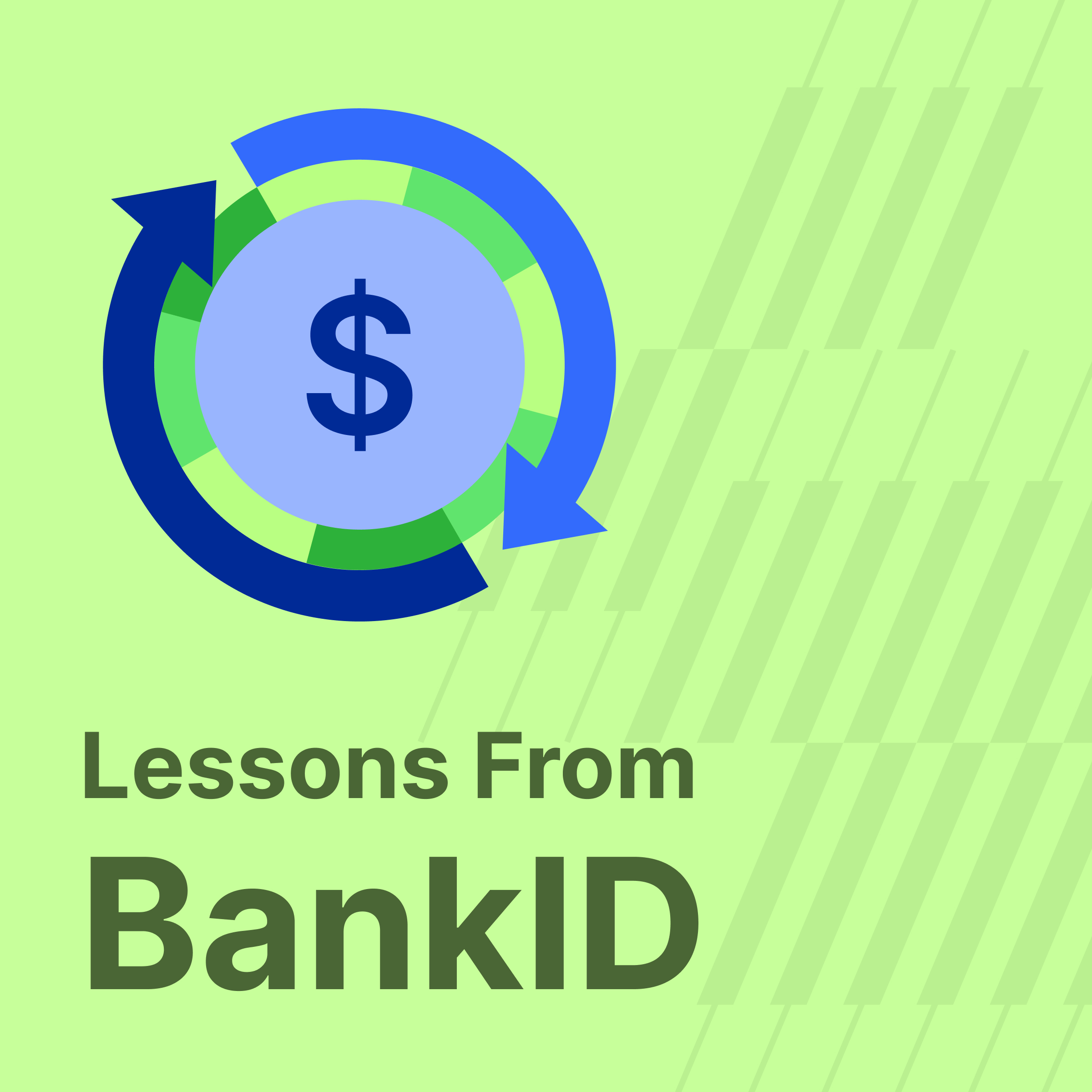
What the U.S. Can Learn from Sweden’s BankID

Updated July 10, 2026
Identity has quietly become one of the most important pieces of infrastructure on the internet. Every financial transaction, contract, account change, and authorization depends on answering a simple question: who is actually on the other side?
In the United States, that answer is often pieced together through passwords, device signals, document uploads, and knowledge-based questions. Each company builds its own version of the process, which leads to repeated friction for customers and inconsistent signals for businesses trying to manage fraud.
Sweden took a different approach. Instead of rebuilding identity inside every service, banks collaborated to create a shared digital identity system called BankID. Over time it became the standard way people in Sweden prove who they are online.
Today more than 8.6 million people use BankID, representing the vast majority of the country’s adult population, and it supports thousands of public and private services across banking, government, healthcare, and commerce.
It did not just streamline logins. It changed how trust works online.
Key takeaways
It did not just streamline logins. It changed how trust works online.
- Sweden's BankID, launched in 2003 by a consortium of banks, now reaches 99.9% of Swedish adults aged 18–67 and supports over 7,500 public and private services — proving that shared digital identity infrastructure can achieve near-universal adoption.
- The core structural insight is that identity verification becomes exponentially more powerful when it's reusable across services rather than rebuilt from scratch by every organization.
- The U.S. lacks a national equivalent, leaving businesses to rely on passwords, knowledge-based questions, and document uploads that were never designed for high-risk digital transactions — creating persistent fraud exposure.
- Sweden is now expanding beyond BankID with a government-backed eID called Sverige-ID, launching December 2026, which will support the EU Digital Identity Wallet and extend access to groups who can't obtain bank-issued credentials.
- The underlying lesson for U.S. organizations is not to wait for a national system — it's to build a cryptographic identity layer that binds verified identities to high-risk actions and produces tamper-evident records that hold up under scrutiny.
- Proof was built to close this gap — providing the reusable, cryptographically secured identity infrastructure that U.S. organizations need for high-value transactions today.
When identity becomes infrastructure
BankID began in 2003 as a partnership between Swedish banks. The idea was straightforward. If every institution needed to verify the same people, it made little sense for each one to build its own identity layer.
Instead, they created a shared credential that organizations could rely on.
Over time the system expanded beyond banking. Citizens now use BankID to file taxes, access government services, sign contracts, authorize payments, and interact with healthcare providers. According to Sweden’s central bank, BankID has become one of the most widely used digital identification tools in the country’s economy.
The effect is subtle but powerful. Once a person establishes a trusted identity, that trust can move with them across services instead of being rebuilt every time.
The US model (or lack thereof)
The United States has not yet developed a shared digital identity system. Instead, identity verification evolved independently inside banks, marketplaces, fintech platforms, and government agencies.
That decentralized model created innovation, but it also introduced gaps. Research from the Federal Trade Commission shows that identity fraud continues to rise in the US, with millions of consumers reporting identity theft each year.
Organizations often rely on signals that were never designed for high-risk digital transactions. Passwords get reused. Knowledge-based questions can be answered with information available online. Even document checks can be bypassed by increasingly sophisticated synthetic identities.
This leaves businesses asking the same question repeatedly throughout a customer lifecycle: are we still dealing with the same person?
Why BankID works
BankID’s success is not just about convenience. It reflects a structural shift in how identity is treated. Instead of viewing identity verification as a one-time checkpoint, the system treats it as a reusable trust layer.
That produces a few important advantages:
- First, organizations can rely on a consistent signal rather than rebuilding verification from scratch.
- Second, customers encounter far less friction because they are not repeatedly asked to prove themselves in slightly different ways.
- Third, strong authentication methods tied to cryptography and secure devices make impersonation significantly harder.
None of these benefits come from a single feature. They come from the network effect of shared trust.
The hard part is coordination
If the advantages are so clear, why has the U.S. not built something similar?
Scale and governance play a big role. The U.S. financial system is larger and more fragmented. Regulatory oversight spans federal and state authorities. Privacy expectations vary across industries and regions.
That complexity makes a single national identity system unlikely.
At the same time, digital interactions are becoming more sensitive. High-value payments, remote agreements, account recovery, and automated transactions all depend on stronger proof of identity and authorization.
The pressure to improve digital trust is increasing even without a centralized solution.
The shift toward verifiable credentials
Around the world, a new model of identity is beginning to emerge.
Instead of relying solely on passwords or isolated verification checks, organizations are exploring verifiable digital credentials. These credentials allow individuals to prove attributes about themselves using cryptographic evidence that can be independently validated.
Governments, financial institutions, and technology providers are all investing in this approach because it offers something traditional systems struggle to deliver: portability of trust.
A verified identity does not have to stay locked inside one company’s database. It can be reused across services while still protecting user privacy.
In many ways, this is the underlying lesson of BankID - trust becomes far more powerful when it can move.
The future for US companies
BankID worked because banks collectively decided identity was infrastructure. They built a system other organizations could rely on, and the network effects followed.
The United States is unlikely to produce a single national identity layer. The market is too large, too decentralized, and moving too quickly.
But the underlying need is identical.
Organizations (especially banks) need a way to verify a real person, attach that identity to high-risk actions, and produce evidence that holds up when money, contracts, or access are on the line.
That is exactly the gap Proof was built to solve.
With Proof, your customers establish a cryptographic identity layer that travels with the transaction itself. Instead of relying on passwords, sessions, or one-time checks, organizations gain verifiable proof of who authorized an action and how that authorization occurred.
Identity is bound to:
- real-world verification
- secure credentials
- digital signatures
- tamper-evident records
That evidence persists long after the moment of login.
This is the model BankID proved works. A trusted identity that can be relied on across systems, organizations, and high-value interactions.
The difference is that Proof is building it for the modern internet. Not one country. Not one bank consortium. An interoperable trust layer for digital transactions everywhere.





























.jpg)















































.jpg)