The Sellers Never Showed Up. The Houses Sold Anyway.


On September 4, a federal court in San Diego sentenced Victor Hugo Villalobos Almazan to 27 months in custody and Nayeli Noemi Montoya Rodriguez to 10 months for their roles in a conspiracy that sold two San Diego homes their co-conspirators did not own, then moved roughly $1 million in proceeds out of the country, according to the U.S. Attorney's Office for the Southern District of California.
"It is difficult to imagine a more brazen betrayal of trust than pretending to own someone else's home and selling it for your own gain," said U.S. Attorney Adam Gordon.
The brazenness is the headline. The mechanics are the part worth studying, because nothing in this scheme needed a sophisticated forgery to survive contact with a closing.
Nobody ever had to be present
According to the plea agreement, co-conspirators created email addresses that closely resembled those of the legitimate property owners and used them to market properties they did not own. Every negotiation ran through those addresses. Prosecutors were explicit about the reason: conducting the transactions entirely by email let them avoid meeting buyers in person and concealed their identities.
That is the detail to sit with. This was not a fraudster presenting a convincing fake ID and beating a verification step. There was no verification step to beat. The scheme was designed around the absence of one, and the process accommodated that absence all the way to a transferred property.
Once a sale was arranged, the co-conspirators used forged property transfer documents that falsely appeared to bear the owner's signature, and ownership moved to an unwitting buyer.
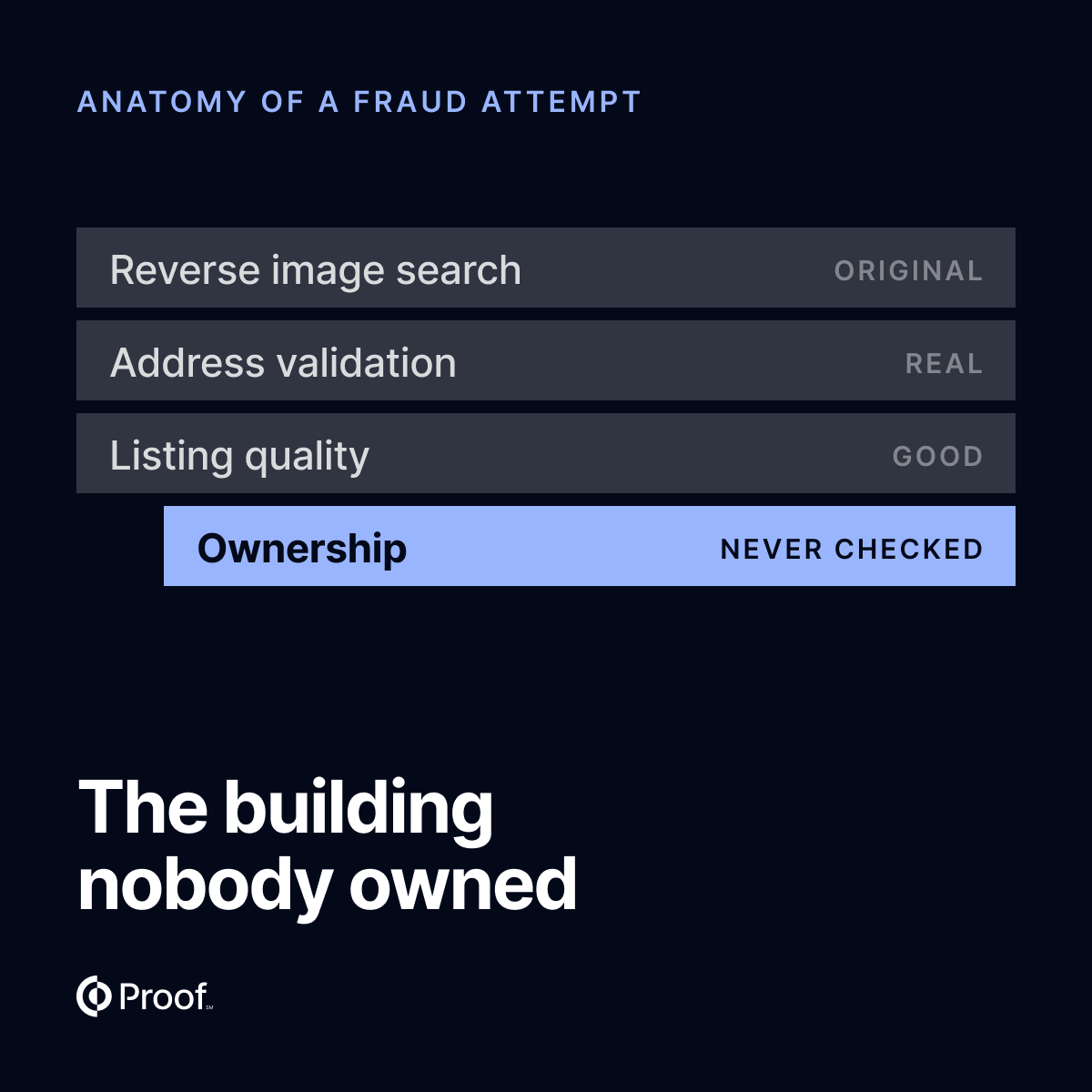
Every control that ran was a name match
Look at what this scheme actually had to defeat, and the same weakness appears three times.
The email address resembled the owner's. The signature on the transfer document resembled the owner's. And when the money moved, Villalobos and Montoya admitted to opening bank accounts under business names similar to those of the legitimate property owners, so the proceeds landed somewhere that read as close enough to correct.
Three controls, at three different institutions, and every one of them was confirming that a name looked right rather than that a person was who they claimed to be. A near miss passes a name check. It does not pass a biometric comparison against a government credential.
The money leaves before the paper unwinds
The proceeds tell the second half of the story.
The fraudulent sale of the 36th Street property produced $400,748. In April 2023, Montoya transmitted nearly the entire amount to bank accounts in Mexico. The Hollister Street sale produced $561,463, which Villalobos withdrew through international wires to accounts in Mexico and Jordan, and in cash.
A defective transfer takes months to litigate. A wire clears in hours. By the time anyone in the chain has cause to question who actually signed, the funds are in another jurisdiction, and the timeline has never favored recovery.
A sentence is not a remedy
Both defendants pleaded guilty in June and were sentenced on September 4, more than three years after the first wire went out. Homeland Security Investigations and IRS Criminal Investigation ran the case, and it closed the way these cases are supposed to close.
Twenty seven months and ten months. Roughly $1 million already abroad.
Criminal accountability is real, it arrives late, and it does not undo a fraudulent transfer or return the money to the people who sent it. Someone still absorbs that loss. The question for every closing operation is who, and whether the transaction that produced it ever asked the seller to prove they were the seller.
Where this stops
Identity verification at NIST IAL2, the federal standard for identity assurance, requires the seller to do the one thing this scheme was built to avoid: show up. Government ID capture, liveness detection, and a biometric comparison against that credential, with live human review available on high value transactions.
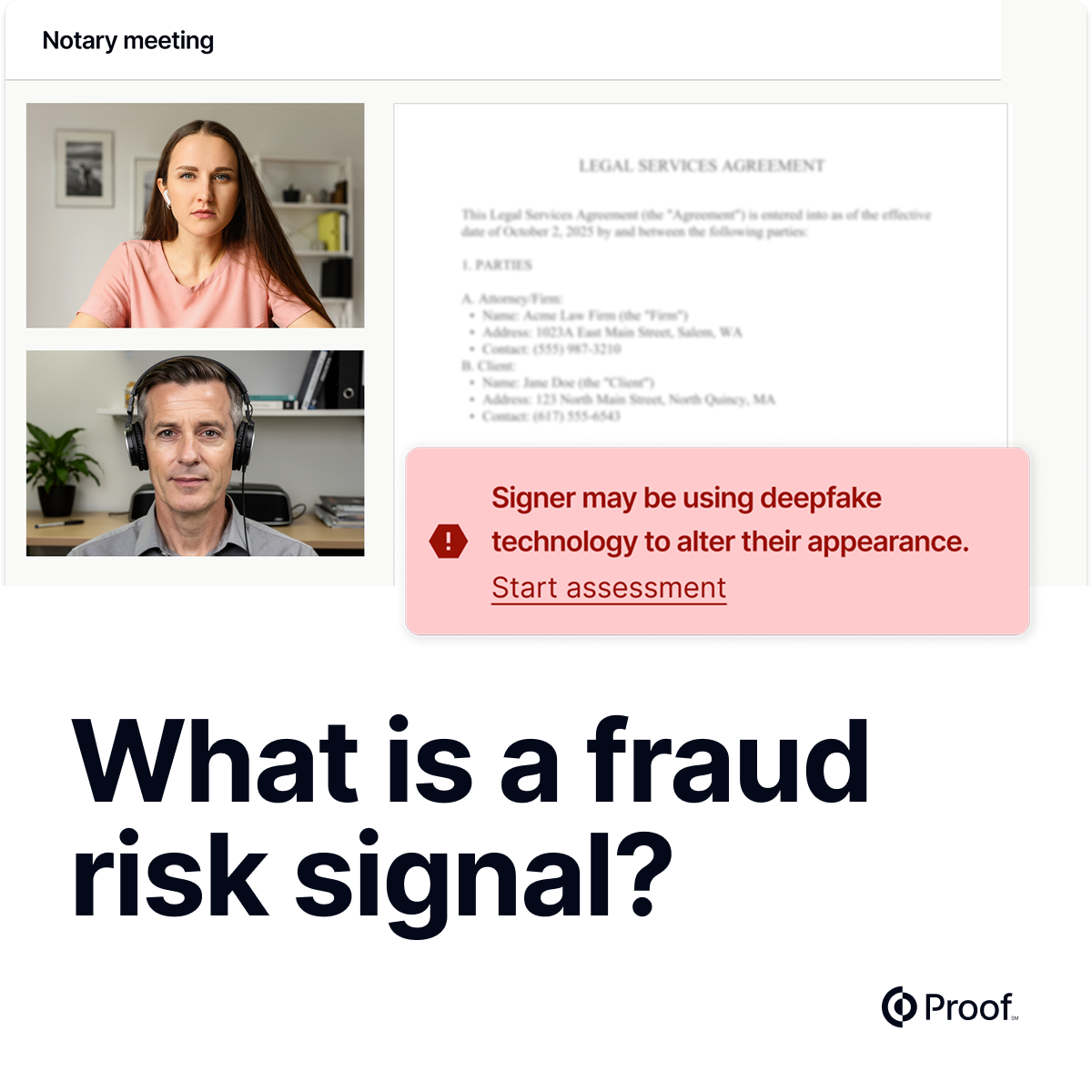
Someone operating a lookalike email address has no path through that. They can forge a signature and they can register an address that reads almost like the owner's. They cannot present a face that matches the identity document of the person whose house they are selling.
What the verification leaves behind matters just as much. Proof issues that verified identity as a cryptographic credential anchored in PKI and bound biometrically to the person it belongs to, and every transaction produces a tamper evident, court admissible record of who was verified, what they authorized, and when. In a disputed transfer, that record replaces reconstruction with evidence.
Proof has spent a decade on transactions where the money does not come back, with more than $640 billion in real estate transactions secured.
The question for closing operations
Two houses in San Diego changed hands without anyone in the process meeting the person selling them. Prosecutors described the buyers as unsuspecting, and the legitimate owners were not party to any of it.
The useful exercise is to ask what in your own process would have caught it. If the answer is document review and a name that matched, this scheme is repeatable against you, and a sentencing in San Diego has not changed that.
If you'd like to see how Proof verifies the parties to a closing before the money moves, you can book time with our team here.





































.jpg)












































.jpg)