Electronic Signatures and Digital Signatures: The Difference and Why It Matters

Someone closing on a house in Ohio, someone signing a distribution agreement between a company in Berlin and one in Singapore, and someone consenting to a telehealth visit in California can all sign electronically. But the standards governing those signatures, and the way the signers are identified can vary, and as a result, they may not guarantee the same things. And details matter because computer-based fraud rates are high and getting higher.
Key takeaways
- PKI (public key infrastructure) is the technical engine that cryptographically binds signatures to documents in an electronic signature (eSignature) systems, but it's only half the battle. The other half is validating the identities of the individuals or organizations to ensure the eSignatures are legally valid in courts.
- In the US, ESIGN and UETA make electronic signatures legally valid but by design, do not impose technical requirements. They establish a basic equality: Electronic signatures are as valid as the physical kind. Following the long-established common law of signatures, the focus is on intent, not execution.
- Outside of the US, electronic signature requirements vary. For example, EU law has a three-tiered approach, and only the top tier, Qualified Electronic Signatures (QES) are explicitly recognized to have the equivalent legal effect of hand-written signatures all over the EU.
- NIST's FIPS 186-5 approves certain digital signature algorithms for use by federal departments and agencies when they process sensitive unclassified information. Despite its limited legal scope, the document is influential in private industry and is referenced by other frameworks and standards that apply to private uses of digital signatures.
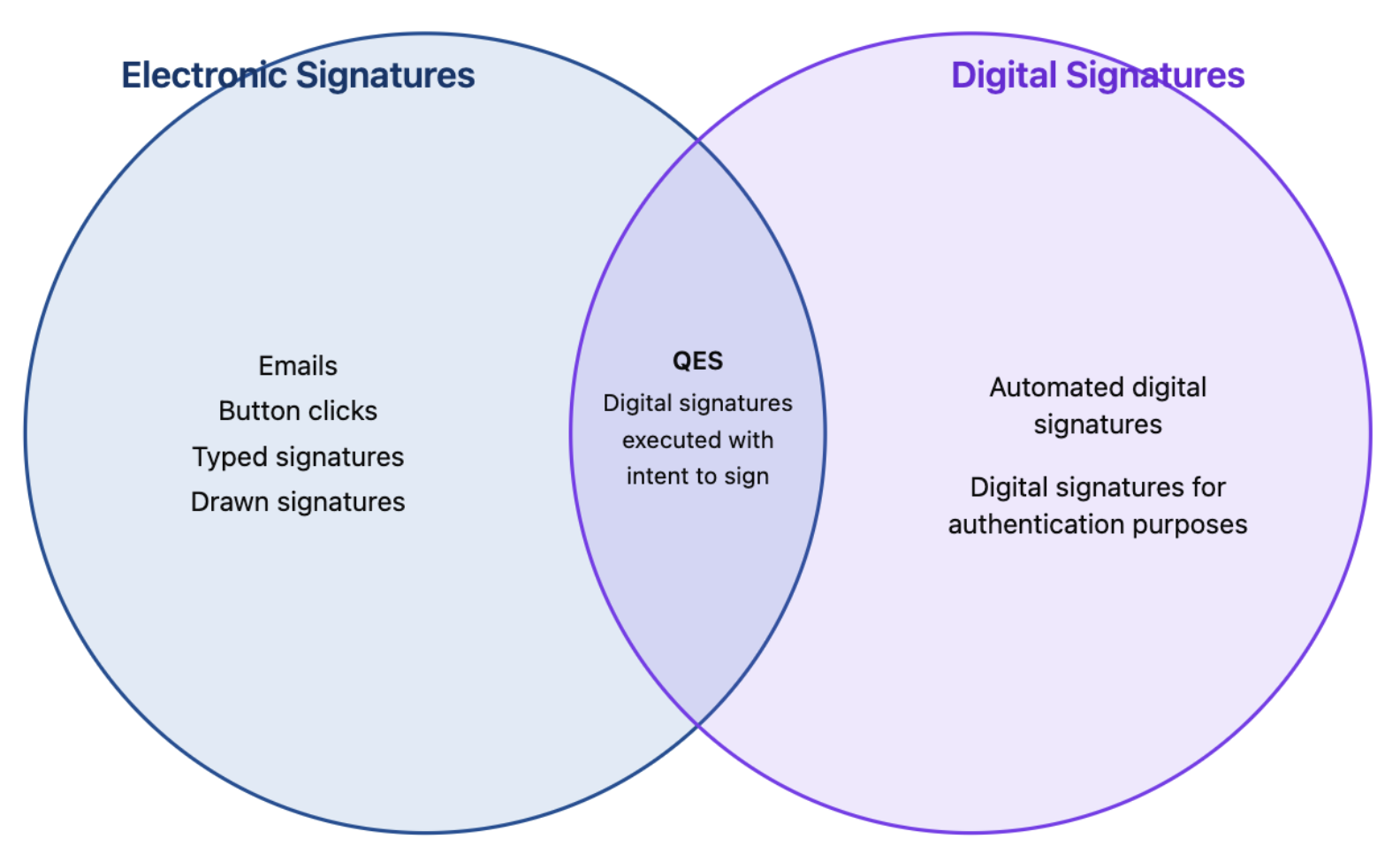
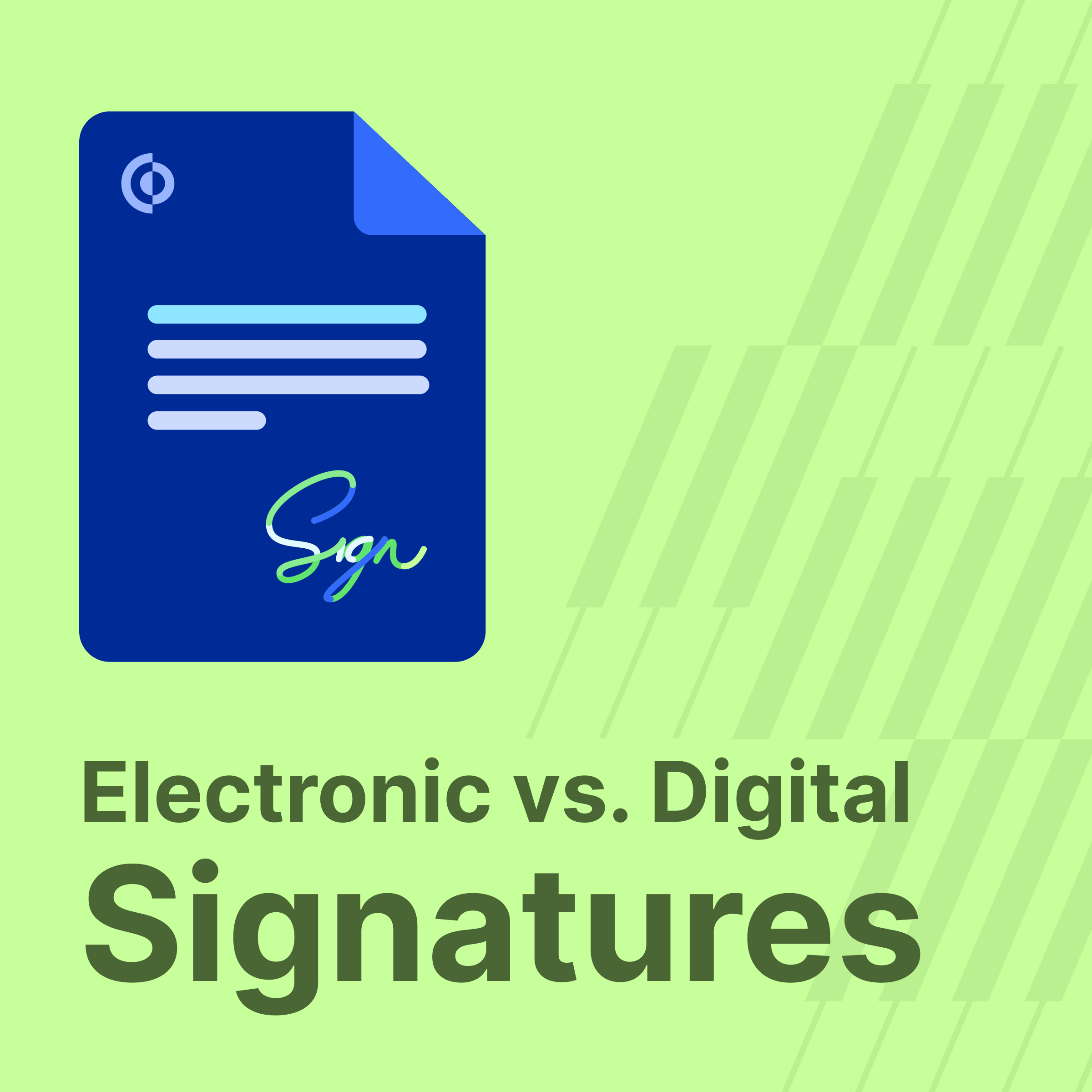
There are two ideas that are often confused: electronic signatures (a legal concept) and digital signatures (a cryptography procedure). It’s easy to confuse the two because a digital signature can be an electronic signature, but not all electronic signatures are digital signatures and not all digital signatures qualify as electronic signatures - the concepts overlap, but only a little.
The US law of electronic signatures: ESIGN and UETA
In the US, the law says, with some exceptions, “an electronic signature is the same as a hand-written one; you can’t reject one just because it wasn’t written by a human with a pen.” The law announces a principle of equality between electronic signatures and the kind you write by hand.
The ESIGN Act establishes that a signature or contract "may not be denied legal effect, validity, or enforceability solely because it is in electronic form."
The Uniform Electronic Transactions Act (UETA) Is a uniform state law (we linked to the Massachusetts statute for ease of reference) that codifies the same equality of signatures.Both laws define electronic signatures in terms of intent to sign: “an electronic sound, symbol, or process attached to or logically associated with a record and executed or adopted by a person with the intent to sign the record.”
For the record, this is consistent with the common law, which never required a person to physically write their name in order to sign something: They could adopt a pre-existing mark or sign with an X. The law of electronic signatures simply codifies the existing law of signatures.
Applying this logic, the laws don’t say much about the how—how electronic signatures are created or how we know who signed. They are wisely technology-neutral. The downside of this technology neutrality is that a signature that meets E-sign and UETA requirements can be anything from soup to nuts: It could be as trivial as clicking “I agree,” on a website, it could be electronically notarized, or it could even be a digital signature using a certificate that was issued after identity was verified to a high level of assurance. You may find this bewildering, but the law’s acceptance of electronic signatures doesn’t stop forgery.
The EU framework: eIDAS the three tiers
In the EU. Regulation (EU) 2024/1183, known as eIDAS 2.0, defines three levels of electronic signature (most of the text is from the European Commission’s website), and different tiers may be required, depending on the transaction.
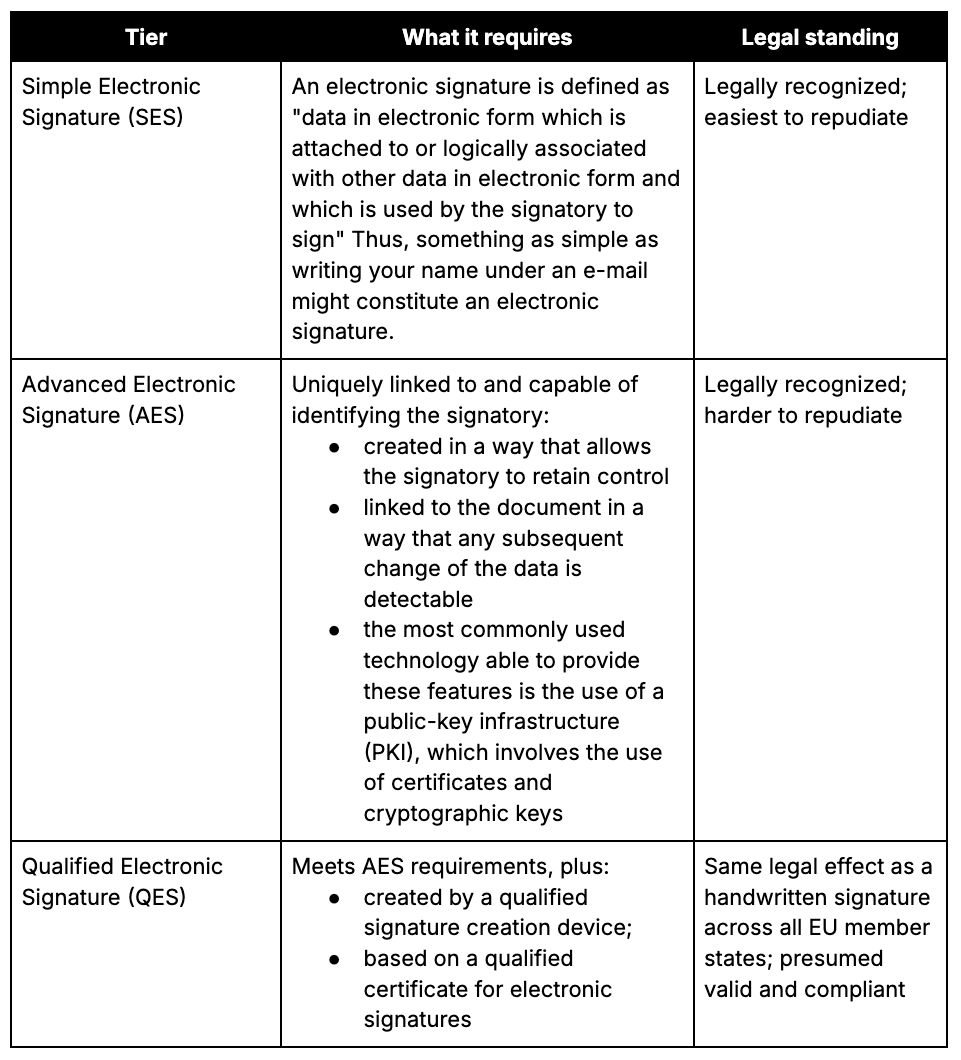
In other words, eIDAS adds two levels of assurance to its electronic signature law that don’t exist in US law. The SES definition is similar to the ones in US laws. The AES requires the signature to be uniquely linked and capable of identifying the signer. And the QES is based on a qualified certificate. Under eIDAS, a qualified certificate is subject to multiple requirements, most notably the issuer must establish a high level of assurance of the identity of the certificate holder. From the perspective of whomever relies on the signature, this is an improvement over both old-school handwritten signatures (the “same legal effect” notion is a backhanded compliment to QES) and the lower tiers. What’s all this talk about certificates? Let’s take a step back.
Digital Signatures and PKI
While electronic signatures are a legal concept, digital signatures are a way of tying an action to an actor, or a signature to a signer. As we’ll see, they are a feature of Public Key Infrastructure (PKI). So let’s start with PKI.
Public key infrastructure, and public key cryptography, is cryptography that is based on a pair of keys: one public, one private. The public key is, well, public; it’s not secret. The private key is secret and only the owner has it. The public key is derived from the private key, but there’s no easy way to get back to the private key, given the public one. That’s called a “work factor.” A cool feature of this key pair architecture is that it permits encryption and decryption in both directions with different benefits.
Lets say Bob wants to send Alice a message that only Alice can read. If he has Alice’s public key, he can use it to encrypt the message. As long as Alice keeps her private key secret, she is the only person who can decrypt the message. This direction creates security and confidentiality. If someone intercepts the message, they can’t read it. It also creates integrity because if someone tries to change the message, Alice will know because the decrypted text will be gibberish.
But for signatures, we’re interested in the other direction. What if Alice wants to send Bob a message, but Bob needs to be sure it’s really from Alice (and that it’s the actual message Alice sent). There are a couple of ways to do this. Alice could encrypt the message with her private key and hit send. Because the key is only linked to Alice, Bob can use her public key to decrypt the message and be confident that she was the one who encrypted it.
This direction offers two features that we haven’t covered yet: Authentication (Bob’s confidence that Alice encrypted the message) and non-repudiation (Alice can’t later deny encrypting the message). Bob and Alice also get integrity here because if someone tampers with the message while it's in transit, the decrypted text will be gibberish. But notice that security and confidentiality vanish: Anyone can decrypt the message using the public key. In this context, authentication, non-repudiation, and integrity are more important. Digital signatures emphasize and enhance these features and make the message readable without decryption.
Before we dive into digital signatures, we need another idea: hashing. Hashing is a form of one-way encryption. It’s meant to assure integrity. A hashing algorithm creates a standard, short, block of text (called a message digest) from a message, no matter the length of the original message. Hashes of the same text will be identical; change a comma and the message digest will be obviously different. For example here is a message digest of the text of the Constitution:
13d59b42325091943d208ba8690478121249daffe6bca0296c06bd648c12f11f
Obviously, we can’t just add water to this and reconstitute the constitution! We can’t get from the message digest to the message. But if we want to make sure we’re both looking at the same text, we can hash them and compare the message digests. They’ll only match if the texts are identical.
There are a lot of hashing algorithms. The one I used was SHA-256. Of course, if Alice hashes his message and sends it to Bob, and Clark intercepts it, Clark can change the message and generate a matching message digest, so Bob needs to do something more, and he still wants authentication and non-repudiation. How can he do that? You guessed it: Digital signatures.
Alice can write a message, generate a message digest, encrypt the digest using her private key, and presto: digital signature magic! This has multiple benefits. First, encrypting and decrypting documents takes time and compute. Messages can be long, and this way is faster and less expensive. Second, Alice may intend her message for a broad audience, most of which doesn’t need authentication. The message is readable to the general public, and can be verified by anyone who cares. Third, hashing is a better way to check integrity. Any reader can take the message text, generate their own message digest, and compare it to the one that’s included with the message (after decrypting that one).
The best practices for digital signatures are spelled out in NIST's FIPS 186-5, which specifies certain digital signature algorithms for use by federal departments and agencies when they process sensitive unclassified information. Despite its limited legal scope, the document is influential in private industry and is referenced by other frameworks and standards that apply to private uses of digital signatures.
Finally, certificates
But how do we know who Alice is? So far we know that it’s “her” private key, but how do we know that and how confident can we be that she’s not an imposter? To understand this, we need two more ideas from PKI: Certificates and Certificate Authorities.
Where do key pairs come from? A business called a certificate authority makes them. When the key pair is created, the certificate authority issues a certificate (hence the name!) which includes the public key. The certificate authenticates the key and contains some information that identifies Alice. But not all certificates are created equal. Depending on the purpose of the key pair and the protocols of the certificate authority, the level of confidence they need varies. Some may only verify access to a web server or an email address, while others require stringent identity verification, such as those identified in NIST’s SP 800-63A.
Digital signatures tie a public keys to their owners; but our confidence in the signer’s identity is based on the level of confidence that the certificate authority gained when it issued the key and certificate.
























.jpg)


































.jpg)