Why The Right Fraud Tools Can Help Stop Seller Impersonation

If you work in title, none of this will surprise you.
The seller you cannot quite reach by phone.
The vacant lot with an out-of-state owner.
The closing that suddenly needs to happen faster than it should.
The American Land Title Association released a study putting numbers to what closing teams have been feeling. Seller impersonation attempts against title firms more than doubled in a single year. In 2024, 28% of firms reported at least one attempt. It is now 59%. Nearly a quarter faced three or more.
And the firms in that study are not standing still. 94% run multiple fraud-detection tools, an average of 5.3 each. They are spending money and adding checks for exactly this. The attempts are climbing anyway.
What the study found
ALTA surveyed 245 title professionals across 40 states, DC, and the U.S. Virgin Islands:
- 59% reported at least one attempt in the prior calendar year, up from 28%
- 45% reported an attempt in the month before the survey, up from 19%
- 23% reported three or more attempts, up from 4%
Vacant land is the most targeted property type, followed by vacation homes, rental properties, and agricultural land. No one lives on site to notice, and the real owner may go months without checking.
Why tools are not catching it
Title firms are not the weak link here. They are the target, and they are paying real money to defend themselves.
The tools they bought do what they were built to do: score a transaction, flag an anomaly, rate a document as probably genuine. Run five and you get five probabilities. The trouble is what those probabilities are built from. A fraudster shows up with a convincing driver's license, a phone number that actually rings, and a voice that matches the file. 87% of firms say spoofed contact information is at least somewhat common.
Every signal your tools read is a signal he chose, so all five agree he looks legitimate while reading the same forged evidence.
And the forgeries are getting better fast. 58% of firms have already run into deepfake image or voice technology. Voice cloning takes seconds of source audio. A forged document is a generated image. The seller on your video call can be synthesized while you watch.
That is a genuinely difficult thing to ask of a closing team. You are judging whether a person is who they say they are, using evidence that can now be manufactured end to end. Care and experience do not fix it. The problem was never attention. The thing in front of you was built to pass.
Elizabeth Blosser, ALTA's Chief Strategy, Communications and Innovation Officer, put it plainly: "Criminals are investing time and resources to exploit weaknesses in real estate transactions, which means our industry must remain equally committed to strengthening safeguards."
Looking legitimate and being the owner are different things. Detection software can only answer the first part, and the safeguards that hold are the ones an attacker cannot generate.
Someone absorbs the loss
Twenty-five percent of firms that reported an attempt also reported a paid claim. Among firms that disclosed average costs, half reported expenses above $100,000.
Behind each of those numbers is a wire that left the account, an underwriter writing a check, and an owner who learned that land in their name had been sold by a stranger. Often that owner is elderly, lives in another state, or inherited a parcel they drive out to once a year. Enforcement comes later, if it comes at all, and it rarely brings the money back.
For the agency, the cost is not only the claim. When a closing is disputed, nobody asks whether your team followed procedure. They ask who was verified, what that person authorized, and when. Most closing files were never designed to answer that.
What actually closes the gap
The answer is not a sixth scoring tool. Instead, organizations need to shift focus to verifying the person before the transaction moves, and keeping a record proving the check took place, including:
- NIST IAL2 identity verification, with government ID capture and a real-time biometric selfie compared against that credential
- AAMVA integration, checking U.S. driver's licenses against DMV records in real time rather than by eye
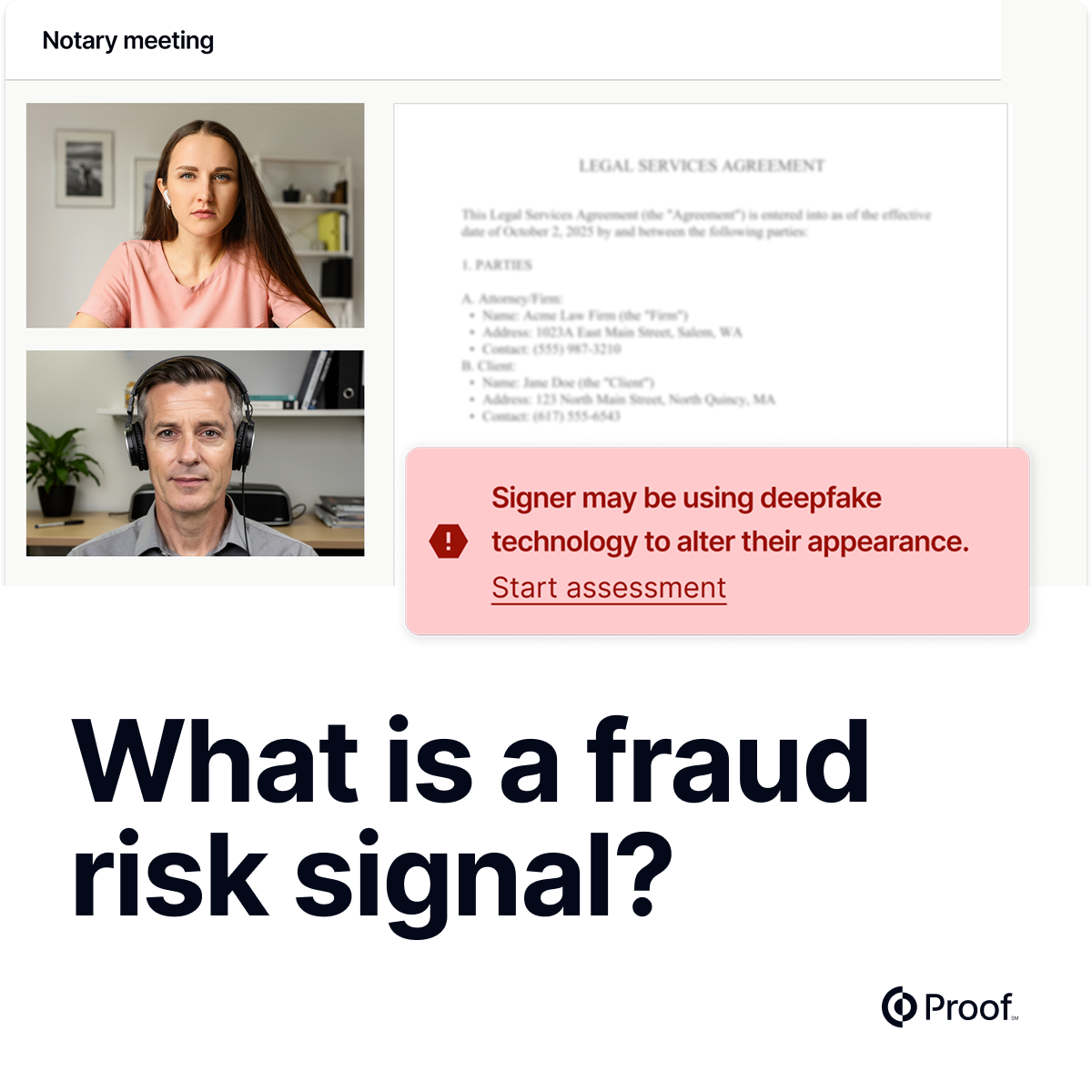
- Liveness and deepfake detection, trained on identity-context video, rejecting synthetic faces and replayed footage
- Trusted Referees, trained people who review high-risk sessions live, a model NIST recognizes in SP 800-63A for the cases automation gets wrong
- Defend, monitoring more than 400 fraud risk signals across sessions and organizations, so a pattern stays visible even when one transaction looks clean
Each verification produces a tamper-evident, court-admissible record anchored in PKI, tying a verified person to a specific authorization at a specific moment. If a closing is challenged three years from now, you are not reconstructing what happened from memory and a folder. The evidence is already there.
Proof has secured more than $640 billion in real estate closings on this model.
Where this is heading
Title firms are spending more on detection and losing more to impersonation. When that happens, the control being strengthened is usually not the control that matters. Detection asks whether a transaction looks legitimate. Identity proofing answers whether the seller is the owner, before anything moves.
Attempts are climbing, deepfakes are getting cheaper, and underwriters and regulators are beginning to ask what standard was actually applied at the table. That is not a conversation you win with a description of your process. But you can walk into it with a record.
The question is no longer whether seller impersonation reaches your closing table. It is whether you can prove who sat at it.
If you'd like to see how Proof verifies seller identity before a closing proceeds, you can book time with our team here.



















.jpg)










































.jpg)