The Future of Real Estate Agents: What Buying and Selling Houses Will Look Like in 2030


Updated September 10, 2026
According to seven real estate experts, the future of real estate agents depends on which tier of the market they serve and how quickly they adapt to technology-driven brokerage models.
Real estate agents have largely avoided the displacement that erased human brokers from travel and stock trading. But that resistance to change has limits. Venture capital has poured into iBuyers, proptech platforms, and hybrid brokerage models that are compressing commissions, automating routine tasks, and reshaping what it means to be an agent. The question for brokers, brokerage leaders, and proptech professionals is no longer whether the industry will change by 2030. It is which tier of the market they will occupy when it does.
Key takeaways
- Experts predict iBuyers and tech platforms will capture 10% to 15% of home sales by 2030, concentrated in Sunbelt markets with standardized housing stock.
- The future of real estate brokerage will split into three tiers: fully automated platforms for entry-level transactions, hybrid assembly-line brokerages for the middle market, and high-touch advisory services for luxury and complex deals.
- Fewer agents will close more deals. One brokerage co-founder projects that agents will handle 10 to 20 times more transactions per year than the current average.
- As transactions move online, identity fraud and document manipulation become primary risks. Digital platforms handling high-value property transfers need layered verification to maintain trust.
- The March 2024 National Association of Realtors (NAR) settlement removed the requirement for listing agents to offer buyer-agent compensation through the MLS, accelerating commission compression across the industry.
- Agents who specialize, adopt technology, and anchor their value in trust and judgment will gain market share. Those who do not will consolidate into fewer roles or exit the profession.
Will real estate agents still be needed in 2030?
Yes, but the profession will look structurally different. The agents who remain will handle more transactions with more technology, serve more specialized market segments, or both. The ones who get displaced will be those performing tasks that algorithms and automated platforms can now execute faster and cheaper.
Clelia Warburg Peters, president of Warburg Realty and co-founder of proptech venture capital firm MetaProp, frames the slowness of change in real estate as a function of stakes. "People have been less willing to experiment with new models here than in many other areas of their lives," Peters told Business Insider. That reluctance is eroding as digital-native consumers enter the market and as platforms mature.
The three-tier future of real estate brokerage
Peters projects a three-tiered brokerage market by 2030, differentiated by transaction complexity and buyer wealth.
Tier one: automated platforms for entry-level transactions. iBuyers represent the clearest current example. These platforms trade convenience and a guaranteed sale for higher fees and a potentially lower sale price. They have succeeded in Sunbelt cities with standardized housing stock. Peters predicts that between 10% and 15% of home sales will move through iBuyer and similar tech platforms by 2030.
Tier two: hybrid assembly-line brokerages for the middle market. This tier will serve the largest share of buyers and sellers. These brokerages employ agents as salaried workers rather than independent contractors, divide the agent role into specialized functions, and use technology to reduce time spent on prospecting and administrative tasks. Redfin is the clearest current model. New York-based brokerage Prevu extends this further by keeping client relationships online as long as possible, reducing agent overhead per transaction.
Tier three: high-touch advisory services for luxury and complex deals. Traditional brokerage survives at the top of the market, where complexity resists automation. Peters describes this tier as a "private wealth management-style service." Dror Poleg, author of Rethinking Real Estate and co-chair of the Urban Land Institute's Technology and Innovation Council, compares the trajectory to travel agents and stockbrokers: the ones who survive will be specialists, not generalists.
How iBuyers are reshaping the entry-level market
iBuyers make automated cash offers on homes, removing the traditional listing and negotiation process. The appeal is speed and certainty. The tradeoff is cost.
Steve Murray, president and owner of Real Trends, a real estate research and consulting firm, notes that iBuyer advocates argue that faster, simpler transactions could increase overall sales volume. "It could influence the number of people who are buying and selling," Murray said.
The risk is balance sheet exposure. Ryan Freedman, general partner at Corigin Ventures, an early-stage real estate technology investor, is direct about the vulnerability. "The companies are taking a massive amount of balance sheet risks with these assets of single family homes," Freedman said. "When the value of those homes change, I'm not sure how that plays out for these companies."
Columbia Business School research published in 2025 confirms this structural weakness. iBuying works best for newer, standardized properties in liquid markets. A valuation error of just above 5% is enough to attract sellers with overpriced properties, creating adverse selection that compresses margins and accelerates market share loss. Zillow exited iBuying in 2021 after nearly $900 million in losses. Redfin followed in 2022.
Despite those failures, the model is not finished. Kurt Ramirez, general partner at Nine Four Ventures, a real estate and built-world technology venture firm, has watched iBuyers begin bundling title, escrow, and mortgage services into the transaction. Bundling improves margins and creates stickier customer relationships. Even Poleg, a skeptic of fully automated transactions, acknowledges that iBuyers are now hiring brokers for the selling side. "They're finding that they can't do it all on the computer," Poleg said.
The assembly-line brokerage and the future of agent productivity
The middle tier of the market will look less like a traditional brokerage and more like a specialized service operation. These brokerages will divide what was once a single agent role into multiple functions: lead generation, client relationship management, transaction coordination, and closing support.
The National Association of Realtors (NAR) reported that 26% of agents were already working on agent teams in 2018. Hybrid brokerages take that division of labor further by using technology to standardize each function and reduce the cost per transaction.
Thomas Kutzman, co-CEO and co-founder of Prevu, projects the outcome clearly. "There will be drastically less real estate agents overall capable of doing 10 to 20 times more deals per year than the average agent in the United States today," Kutzman wrote to Business Insider.
As machine learning and natural language processing improve, these hybrid models will automate more of the workflow. Bundling home insurance, title, and mortgage into the transaction will further compress commissions while improving margins for the brokerage.
How the NAR settlement is accelerating commission compression
The March 2024 NAR settlement removed the requirement for listing agents to offer buyer-agent compensation through the Multiple Listing Service (MLS). It mandated written agreements with clear, negotiable compensation terms and prohibited vague fee language.
The immediate effect has been limited. But the long-term trajectory is downward pressure on buyer-agent fees, increased consumer awareness of agent costs, and intensified competition among brokerages. Columbia Business School research suggests that combined with AI-assisted platforms, these regulatory changes could drive broader fee reductions and reshape how buyers and sellers interact with agents.
Murray notes that commissions have been declining slowly since the 1990s. The NAR settlement accelerates a trend that was already underway.
Identity fraud is the risk no one is talking about
As real estate transactions move online and human oversight decreases, fraud risk increases. This is the gap that most industry analysis ignores.
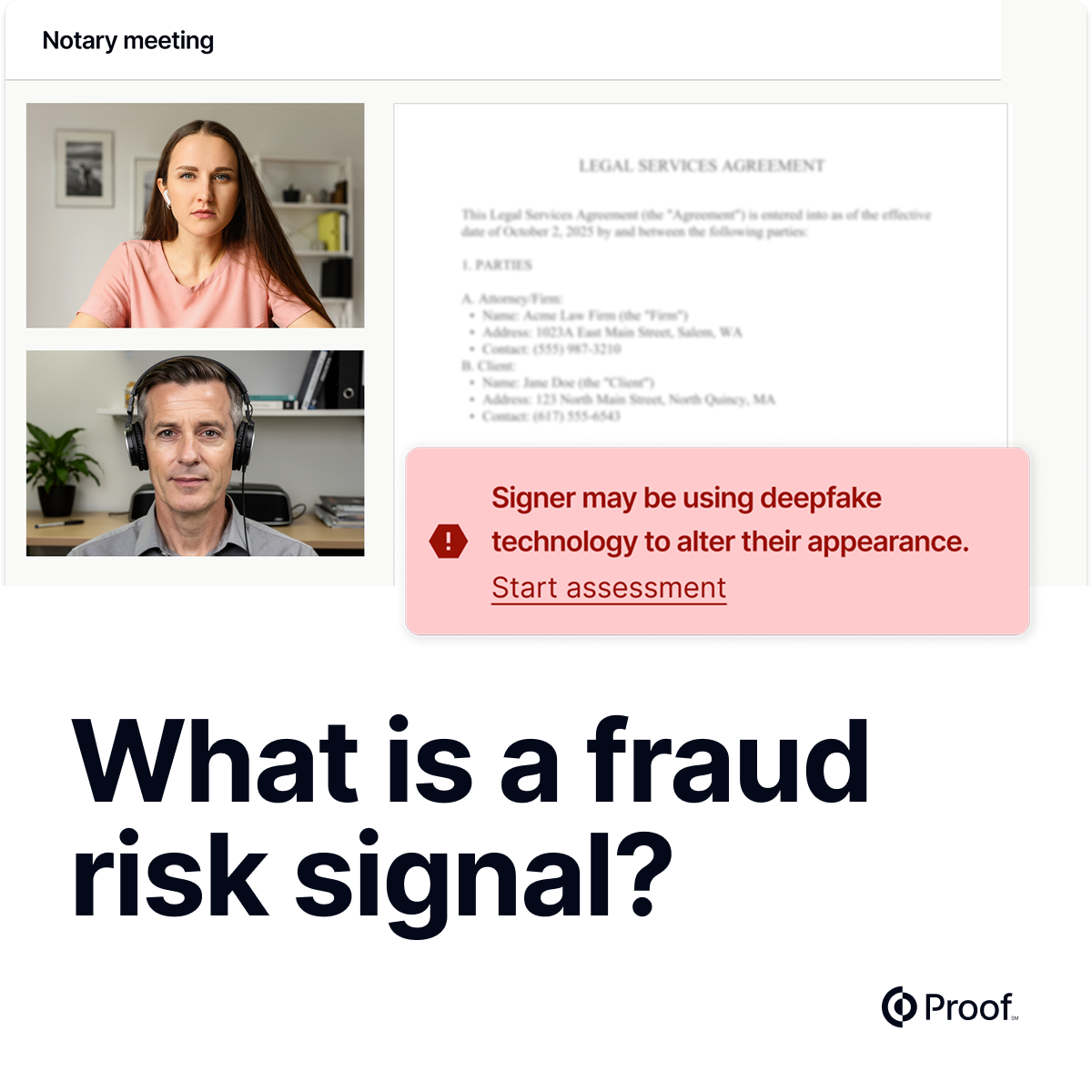
Real estate fraud losses reached $275 million in 2025, a 58% increase in a single year. When iBuyers, hybrid brokerages, and integrated platforms handle larger transaction volumes with minimal in-person verification, the attack surface expands. Bad actors can impersonate legitimate parties, submit forged documents, manipulate wire transfer instructions, and exploit gaps in digital identity confirmation.
The shift toward digital-first transactions means that traditional verification methods, including in-person document review and face-to-face identity confirmation, need digital equivalents that are equally rigorous. This is especially critical as platforms bundle title, escrow, mortgage, and insurance into single digital workflows. Each additional service brings its own documentation requirements and compliance obligations. When those previously separate processes converge, document fraud and manipulation risk grows.
Different states also maintain different requirements for notarization, witnessing, and document execution in real estate transactions. Remote online notarization (RON) is now legal in 49 states and the District of Columbia as of 2026. California's permanent RON statute takes effect January 1, 2030. Platforms operating across state lines must enforce compliance rules that vary by jurisdiction, property type, and underwriter.
Agents and brokerages that understand this risk and partner with platforms that address it will have a defensible advantage. Those that do not will carry liability exposure that grows with every transaction.
What high-touch brokerage looks like in 2030
At the top of the market, traditional brokerage survives as a specialist service. Peters describes it as a private wealth management model: high-trust, high-touch, and priced accordingly.
Poleg sees the parallel to other professions where technology displaced the generalist but preserved the specialist. Travel agents who survived the internet built expertise in complex itineraries, luxury travel, and corporate accounts. Stockbrokers who survived algorithmic trading moved into wealth management and financial planning. Real estate agents at the top tier will follow the same path.
Murray confirms the consolidation is already happening. "The really good agents are picking up market share," he said.
Brokerage models at this tier are also evolving. Ryan Gorman, former CEO at Coldwell Banker, highlighted the RealSure product, which allows brokers to offer clients cash offers valid for 45 days while they test the open market, alongside a rent-to-own program with Home Partners of America. Compass has offered a similar Concierge service. "The best products truly grow the market," Gorman said.
Newer models are pushing further. Companies like Real Broker LLC and Side Inc operate as brokerage-as-a-service platforms: asset-light, brand-free, and designed to help individual agents and agent teams operate as independent businesses with high commission splits. Murray sees this approach "accelerating" and expects it to become more prevalent by 2030.
What digital closing actually requires
The "holy grail" of real estate technology, as Columbia Business School describes it, is a fully digital closing: browse listings, get pre-approved, tour homes, make offers, and close on a single integrated platform without touching paper.
The Rocket Companies acquisition of Redfin signals a serious bet on this outcome. But digital closing is harder than it looks. Even with e-signatures and remote online notarization, delays in appraisals, inspections, and municipal compliance persist. Consumers want speed, but they also want trust, advice, and assurance that the transaction is legitimate.








































.jpg)
























































.jpg)