New
Proof gives AI agents a way to prove what they're authorized to do
Introducing portable identity
Learn more

Proof Digital Credentials give people a verified identity they carry from one business to the next. When an AI agent acts for them, the credential shows which person sent it and exactly what they approved, and your team can check that on its own without a call to Proof.
AI agents already shop, book and pay on people's behalf, and they're moving into banking and payments fast. Most of the systems on the other end were built to confirm that someone logged in. That stops being useful once the person isn't the one clicking.
The session was valid. The customer still says they never agreed.
A customer's finance assistant sends $48,000 to a supplier on a Tuesday afternoon. Two months later the customer disputes it. Your logs show a good session token and a well-behaved agent, but nothing shows that the customer approved that amount going to that payee, which is the one thing the dispute turns on. You either eat the loss or start declining agent traffic you can't vouch for, and good customers get caught in that net.
A signed record of who approved what.
Proof verifies the person and signs their approval of the exact action, down to the amount and payee. When the dispute lands, your team checks that signature itself. There's nothing to request from us and nothing to reconstruct.
And it shares only what that moment calls for. A wine retailer needs to know the buyer is over 21. It has no reason to see their home address, so it never does.
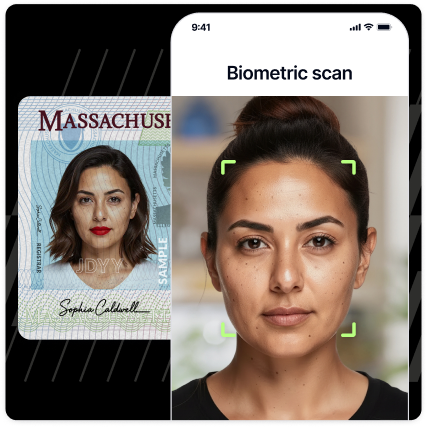
Returning customers present the credential they already hold, and new customers can be verified and issued one in the same visit. It's how a brokerage confirms a login, or how you step up before someone changes a beneficiary.
Verify Identity docs →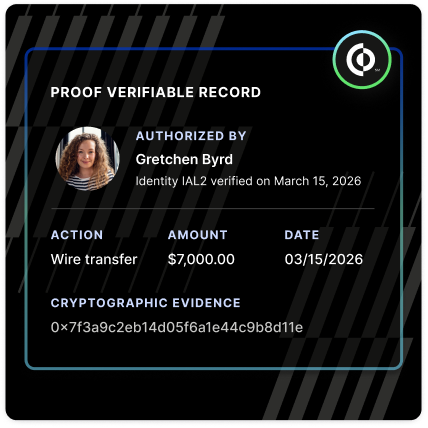
The person sees the transaction details in their wallet and signs them along with their identity. Change a single digit afterward and the signature no longer matches. Treasurers use it for wires, shoppers for itemized baskets.
Sign Transactions docs →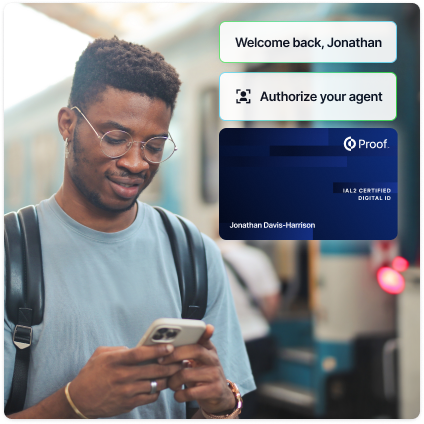
A verified person gives an agent permission to act within limits they set, like a $2,000 travel budget. When the agent shows up at your door, it carries its own credential with a chain back to that person.
Delegate Authority docs →Right now a customer uploads the same driver's license to their bank and then again to their brokerage, and each company keeps its own copy. A Digital Credential works more like a passport. Your systems check it against Proof's root certificate, which you install one time, and the check runs on your side, even offline.
Proof operates its own certificate authority under WebTrust audit. That's the same framework behind the certificates that put the padlock in your browser, so your security team already knows how to evaluate it.
The root key is kept offline in a hardware security module and never signs a credential itself. Its job is to certify five issuing authorities, and each of those is restricted to one kind of artifact. Two of them handle Digital Credentials. The rest secure other parts of Proof's platform, like signed documents and timestamps. All of it runs under a published Certificate Policy that spells out identity checks, key management and revocation.

Bot detection can flag that a request came from software. x401 identifies the person who sent that software, using the same 401 response websites already return when a login is required. It's an open protocol and works with any compatible wallet.
It reaches a protected page or API on a person's behalf.
The usual 401 comes back carrying a request for a Digital Credential.
They confirm in their Proof wallet, right inside the same flow.
Once the signature checks out, the agent gets what it came for.
Ready for the agents your customers already use. Proof publishes agent skill files and an agents trust list, so compatible agents can find and complete x401 flows on their own.
x401.id →Everything here sits on open standards, and the JavaScript SDKs drop into the web stack your team already uses. Each step opens the full technical guide.
Bring us the flow you're worried about, whether that's wire approvals or agents paying on your customers' behalf. We'll show you where Digital Credentials and x401 fit into it.