The Exception Desk: Beneficiary Changes | October 2026


A fraudulent wire transfer announces itself. The customer calls, the reconciliation breaks, and the institution knows within days that a control failed somewhere. The feedback is brutal…but it arrives.
A forged beneficiary designation announces nothing at all. It processes correctly, updates the record correctly, and pays the wrong person years later, usually surfacing when a relative opens a claim letter and realizes the money went somewhere nobody expected.
By then, the one person who could have disputed it has died.
Every other exception desk in the building learns from its mistakes. This one has no way of finding out it made any.
The form outranks the will
Fidelity's transfer-on-death beneficiary form says so on page one, under a heading called Helpful to Know: "This form preempts any terms in your will concerning the accounts in question."
A beneficiary designation decides where an asset goes when the owner dies, regardless of what the will says or what the family understood the owner to want. Everything downstream, from the claim through the payout to the recordkeeping entry, executes the instruction that form carries.
The same form tells the owner what Fidelity will and will not do about it: "Agree that Fidelity has no obligation to locate or notify any beneficiary or to independently verify any information submitted by any person claiming an interest in your account."
Both quotes come from the current version of the form, revised April 2025. Most institutions operate the same way without putting it in writing. An instrument that outranks a will is accepted on the strength of a signature nobody checks.
What actually happens, step by step
The process now splits in two, and most of the volume has moved to the first one.
The portal path. The owner logs in, opens the beneficiary screen, edits the allocations, and confirms. Fidelity's form points customers there directly: "You can change beneficiaries any time at Fidelity.com/beneficiary." Across the major carriers and recordkeepers, online self-service has become the default route for straightforward changes. The authentication protecting it is the account login, the same credential that protects a balance enquiry.
The paper path survives wherever the change is not straightforward: a spouse has to consent, a trust is involved, the beneficiary is irrevocable, or there are more names than the online tool accepts. Empower's current beneficiary designation form, revised June 2026, runs like this.
- Form completed offline. The owner prints it and fills it in by hand, somewhere the institution cannot observe.
- Wet signature applied. Empower prints the same line under every signature block on the form: "A handwritten signature is required on this form. An electronic signature will not be accepted and will result in a significant delay."
- Spousal consent, where the plan requires it. The form states the condition plainly: "If I am married, my Plan requires my spouse to be named as primary beneficiary for 100% of my account balance, or my spouse must consent to my beneficiary designation."
- Notarization of that consent. "The spouse's signature must be notarized by a Notary Public." Somebody now has to go find one.
- Plan administrator signs. A separate block, with its own wet-signature requirement.
- Submission. Upload a photo of the signed pages through the portal, or mail the originals.
- Rejection and restart, if anything is missing. The form warns about this in the field labels themselves: "Relationship (Required - If Relationship is not provided, request will be rejected and sent back for clarification.)" Allocations that fail to total 100% bounce the same way.
- Record updated, and then nothing happens for years. The designation sits until someone submits a death claim.
The anti-fraud measure on Empower's form is a sentence printed above the participant's signature: "Any person who presents a false or fraudulent claim is subject to criminal and civil penalties." Warning labels deter the people who were going to comply anyway.
Where the control actually breaks
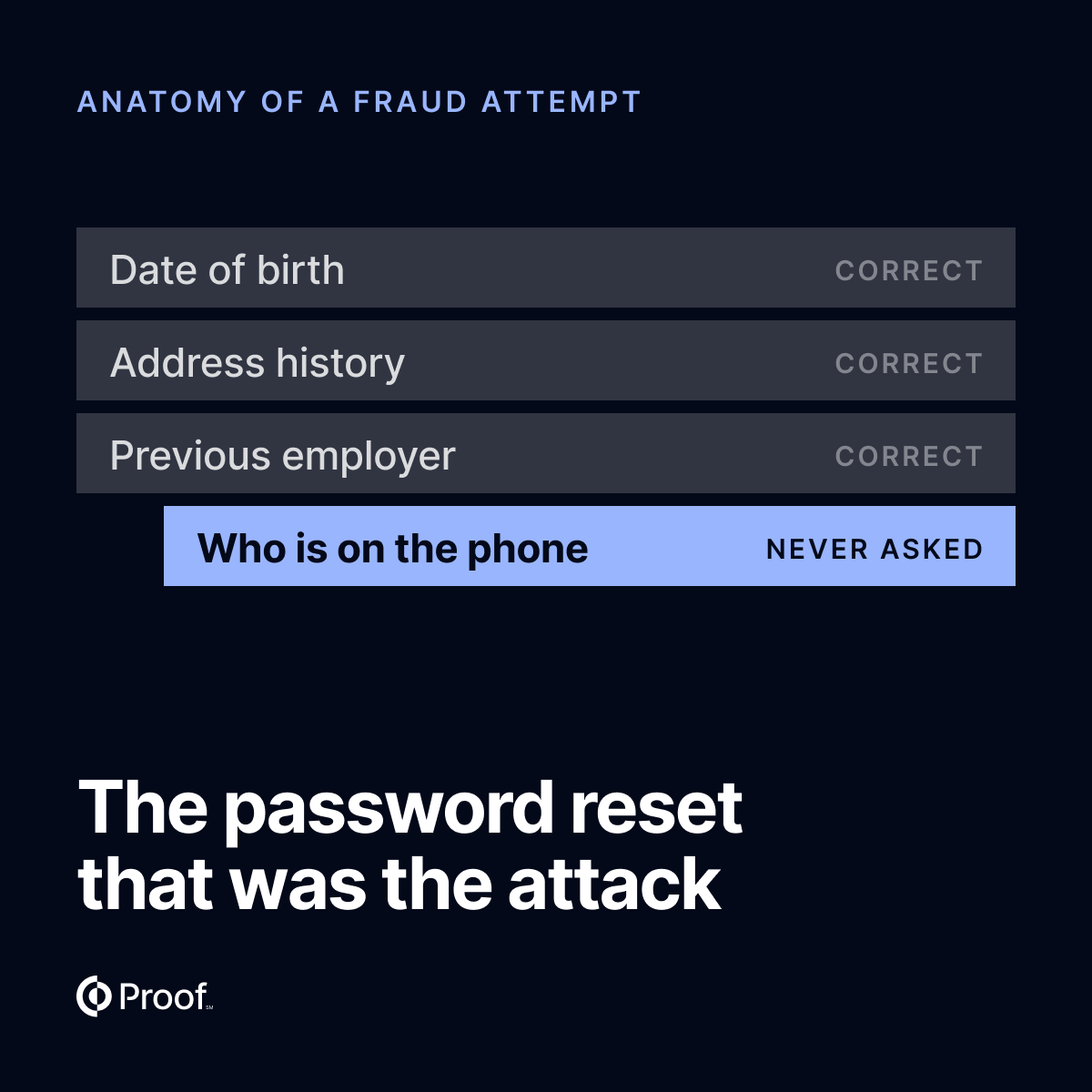
Neither path establishes who made the change.
The portal authenticates a session, which tells the institution that someone holding the credentials was logged in. The paper path collects a signature and compares it against nothing. Fidelity's transfer-on-death form requires the owner's signature and no witness, no notary, and no identity step of any kind, and the only completeness rule it states is that "Any Form that is not signed and dated by the account holder will not be accepted." A signature has to exist. Whether it is genuine never comes up.
The one notarization in the workflow is pointed at the wrong person.
On Empower's form the notary attests to the spouse, certifying someone "proved to me on the basis of satisfactory evidence to be the person who appeared before me." The spouse is the party giving something up. The owner, the party giving the asset away, signs unwitnessed. An institution running this process can tell you with real confidence who consented, while having almost no idea who designated.
Digitizing the paper did not digitize the proof.
Empower accepts the completed form as an upload through the portal, so a phone photograph of a sheet of paper satisfies a requirement written for wet ink. The handwritten signature is enforced as an artifact, and the artifact survives the scan while the evidence was never there to begin with.
The population is selected for vulnerability.
NASAA's guide for firms lists "sudden changes to financial documents such as powers of attorney, account beneficiaries, wills, or trusts" among the signs of senior financial exploitation. The surrounding problem is growing quickly. The FBI's 2025 figures record more than 201,000 complaints from victims over 60 and more than $7.7 billion in reported losses, with complaints up 37% and losses up 59% against the previous year. Average reported loss for an older victim exceeded $38,000, and at least 12,400 of them lost $100,000 or more.
Why this exception never gets fixed
Operations teams fix what shows up in a loss report. The queue is finite, and the items carrying dollar figures go to the front of it.
Beneficiary changes never show up there, and the measurement gap is demonstrable. Every dataset that counts elder financial loss is built from money leaving an account: investment schemes, tech support, romance, government impersonation, phishing. The FBI's elder fraud picture is composed entirely of those categories. A beneficiary change moves no money on the day it happens, so it appears nowhere in any of them.
So an institution cannot tell you its beneficiary fraud rate. The systems built to measure fraud are organized around money leaving an account, and this is the one instruction that changes who the money belongs to without moving any of it. That means the opening question for a customer is whether they could even tell you what this costs them.
What taking it digital actually means
The portal already made this faster, so speed was never the problem. The changes that matter are these:
Verify the owner at the moment of signing.
The person changing the designation completes an identity verification that binds a documented human being to that instruction, using document authentication alongside a biometric match with liveness detection. Neither path contains this step today, on any of these account types.
Make the designation a verifiable record rather than an image of paper or a database row.
The output should be tamper-evident, timestamped, and cryptographically bound to that verified identity, so that when a claim arrives in 2041 the institution holds evidence of who signed instead of a scan and a login timestamp.
Handle any required notarization in the same session.
Where a spousal consent needs a notary, the spouse signs and the notarization happens remotely, inside the flow, instead of sending someone out to find one and mail paper back.
If a caregiver has the owner's mail, their paperwork, their login, and a pen, does the process fail closed? Today it doesn't. It fails quietly, and the institution finds out at the funeral, assuming it finds out at all.
Where Proof fits
The hole in this process is an identity hole - so that’s also where the fix starts.
Proof Identify runs a NIST IAL2 compliant verification on the owner before the instruction counts for anything, combining document authentication with a biometric match. Neither the portal path nor the paper path does this today, which makes it the change that closes the actual gap.
Certify turns the result into a verifiable record, and beneficiary designations are one of its named use cases. The designation gets cryptographically signed and bound to the signer's verified identity, so what sits in the file decades later is digital evidence of who signed rather than an image of a signature.
Proof Digital ID carries that same credential into every subsequent interaction, issued to the person and bound to a key they control.
And where a spousal consent requires a notary, Notarize handles that remotely so nobody has to go find one and mail paper back. That branch applies to workplace retirement plans rather than to life policies or individual retirement accounts, so it addresses the narrower part of the problem.
A fraudulent wire fails loudly. A forged beneficiary designation fails quietly, in favor of whoever happened to be standing closest to an elderly person holding a pen, and the institution processes it correctly, pays it out correctly, and gets it entirely wrong while generating a complete and perfectly useless audit trail.
Everything in this process rests on one fact that nobody currently establishes: who signed.
Count the identity checks in your own beneficiary workflow, on the portal path and the paper path both, from the moment the instruction arrives to the moment the record updates. If the count comes back at zero, talk to Proof about what it would take to change that.