Agentic commerce is here. The proof of authority is missing.

Most of the conversation about agentic commerce thus far has been about checkout, about whether an agent can click "buy." Blocked agents aside, that question misses the big picture of where agentic is headed. Today you tell a merchant what you want to buy, but tomorrow you'll tell an agent what you want to happen, and it in turn will take action to make it happen, from purchases to account openings to high-stakes decisions like insurance.
Right now, there's a missing layer of proof of authority for agents. If an agent's action isn't authorized by a human with a real, verified legal identity, problems ensue across the financial ecosystem. Say an agent spends $250 on a service for you, and you dispute the charge a week later. Your bank asks who authorized it, the merchant turns out never to have dealt with that agent, and the network wants evidence, yet every one of them is working from a record that was built for a person clicking a buy button.
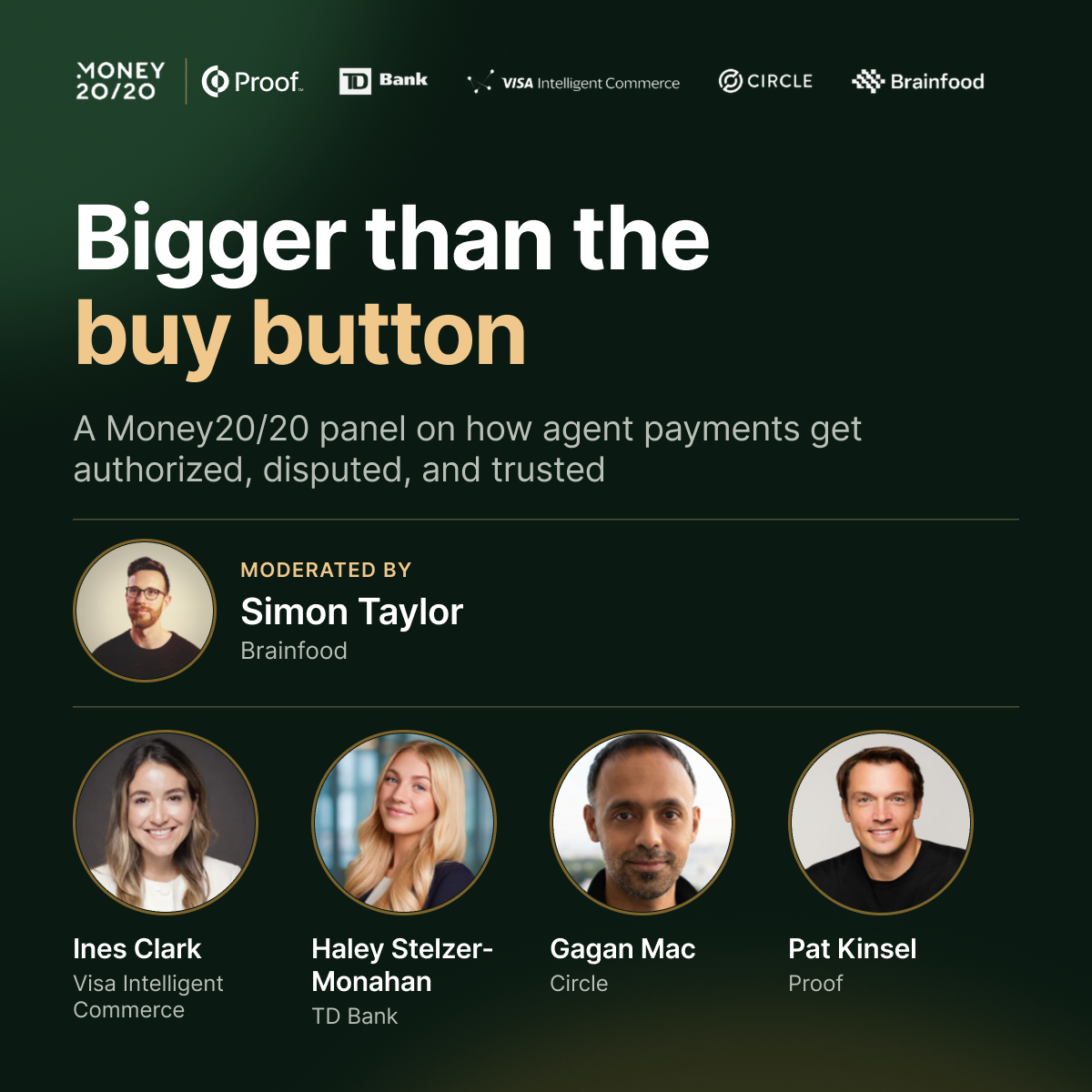
At Money20/20 in Las Vegas, Simon Taylor of Brainfood moderated a panel called Bigger than the buy button with Ines Clark of Visa Intelligent Commerce, Haley Stelzer-Monahan of TD Bank, Gagan Mac of Circle, and Proof CEO Pat Kinsel. Each of them described a version of the same requirement. Every type of company needs to know there's a verified human behind the agent, and every one needs a signed record of what that human approved.
Agents are clicking "buy" already, so the disputes are coming whether the records are ready or not. The question that persists on agents is whether to block, allow, or verify.
The shift: Clicking "buy" is moving from humans to agents
Last month, Meta launched Muse, and Amazon almost immediately blocked it because it couldn't reliably tell whether a human had authorized the agent's actions. Large banks face the same conundrum and have started pushing back on agents transacting on their rails. Moderator Taylor asked the panel to pick a side, block agents or allow them, and the panel aligned on a unified position quickly.
"We are team authorized."
Kinsel called it the hot question in the agent space. "How do we actually know who is behind the agent, and what they actually authorized?"
The reality: What each operator is seeing today
Clark, VP of Agentic Strategy at Visa Intelligent Commerce, said the discussion would have looked completely different two months ago. Visa Intelligent Commerce now offers agentic tokens with spend guardrails built in, and she said agents have to be verified as trusted before a merchant lets them in. "I think we need to see more volume," she added.
Stelzer-Monahan, VP of Partnerships & Innovation at TD Bank, said corporate clients are putting agents on "invoice matching, reconciliation, forecasting, researching missing remittance data or exceptions, and preparing payments, but still with that human in the loop."
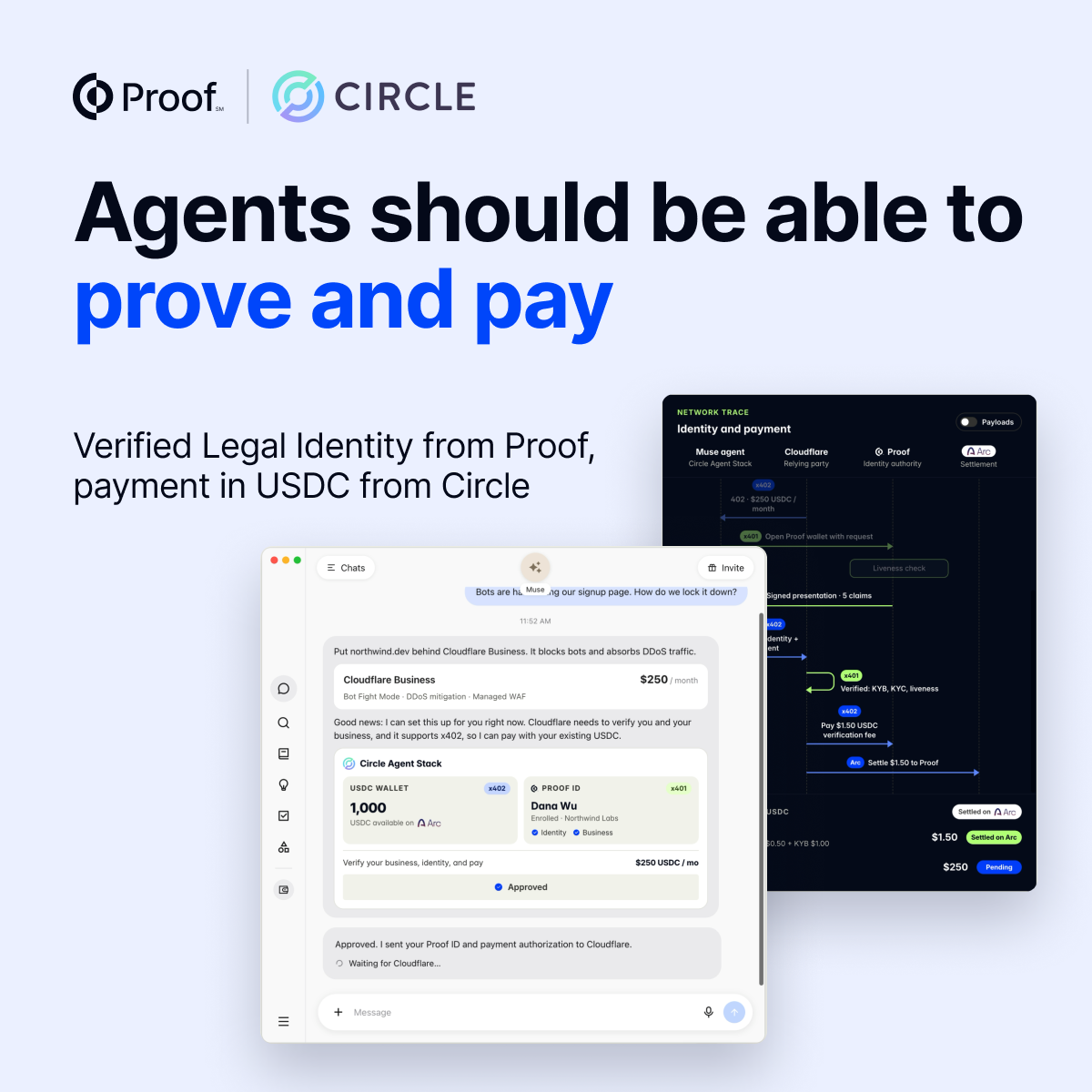
Circle sees software buying from software. Mac, the company's VP of Product, said agents use x402 with x401 for authorization and USDC for payments.
In practice: Where policy ends and mandate begins
Wallets handle policy well but don't carry intent, and Mac drew the line with one example. "Policy could be: spend up to $5,000, never more than $100 per transaction. A mandate would be: I authorize you to spend up to $250 for getting this service. And that intent needs to be carried through along with the transaction." Explicit mandates, in his words, are "the missing piece."
Kinsel said the person gets that authority from a credential issued to them, which they sign, "binding their identity to the explicit thing they're authorizing at the time of the transaction."
The reckoning: Who is on the hook when an agent acts
Stelzer-Monahan laid out the old test at a bank. When a corporate client says it never authorized a payment, TD checks whether an instruction came in and goes back to the client. With agents, the bank now has to ask "What agent was registered? What authority was given? What triggered that?" The harder question, she said, is "Should the agent have actually been given that decision in the first place?"
The answer Kinsel gave is one data object that holds the signature, the data, and the mandate. Because Proof is a trusted root issuer of credentials, a merchant, a bank, or a network can verify it even offline.
The horizon: What has to be true before agents get more room
Taylor closed by asking each panelist what has to be true before their institution lets an agent do more. For TD Bank, Stelzer-Monahan said "We need to see that there's a registered agent at the corporate, that there's a verifying human that actually set that up, and we need to see the mandate. We need to see the limits, we need to see the guardrails, and back to auditability, we need to make sure that we can track that."
Clark expects a richer conversation in about six months, once there is data on how different actors perform.
Kinsel went last. "I'm going to be the guy who says you already can."
In the live Q&A, an attendee asked about a merchant with no relationship to the agent. Kinsel said x401 was designed for that case. "As a merchant you shouldn't have to read all this stuff. You should just turn it on and it should work."
Line up what Visa Intelligent Commerce, TD Bank, and Circle asked for and the same gap appears in all three, the missing record of who approved the purchase and what exactly they approved.
Get your site agent-ready today with x401
x401 is an open protocol that lets a site require verified identity and a signed approval of the exact transaction terms. Proof's MCP server is live in production and works with Meta's Muse, ChatGPT, Grok, Claude, and Cloudflare Workers, and a site can put x401 in front of an endpoint in about an hour.
Proof and Circle announced a collaboration the same day. An AI agent presents a verified Proof credential over x401, pays in USDC over x402 from a Circle Agent Wallet, and the merchant keeps a signed record of who approved the purchase.
If the amount or the recipient changes after the person signs, the signature stops verifying. Agents are buying today, and the teams that put x401 in place now will hold the record when the first dispute arrives.
Read the x401 spec to learn how you can get started >