Identity On-Chain: What It Could Mean for Compliance, Trust, and the Future of Crypto

Updated July 13, 2026
Crypto has reached a familiar inflection point. Adoption is growing, institutional interest is accelerating, and regulators are paying closer attention. At the same time, the industry is still grappling with a core tension: how to meet compliance obligations without undermining the values that made crypto compelling in the first place.
That is where the idea of identity on-chain enters the conversation.
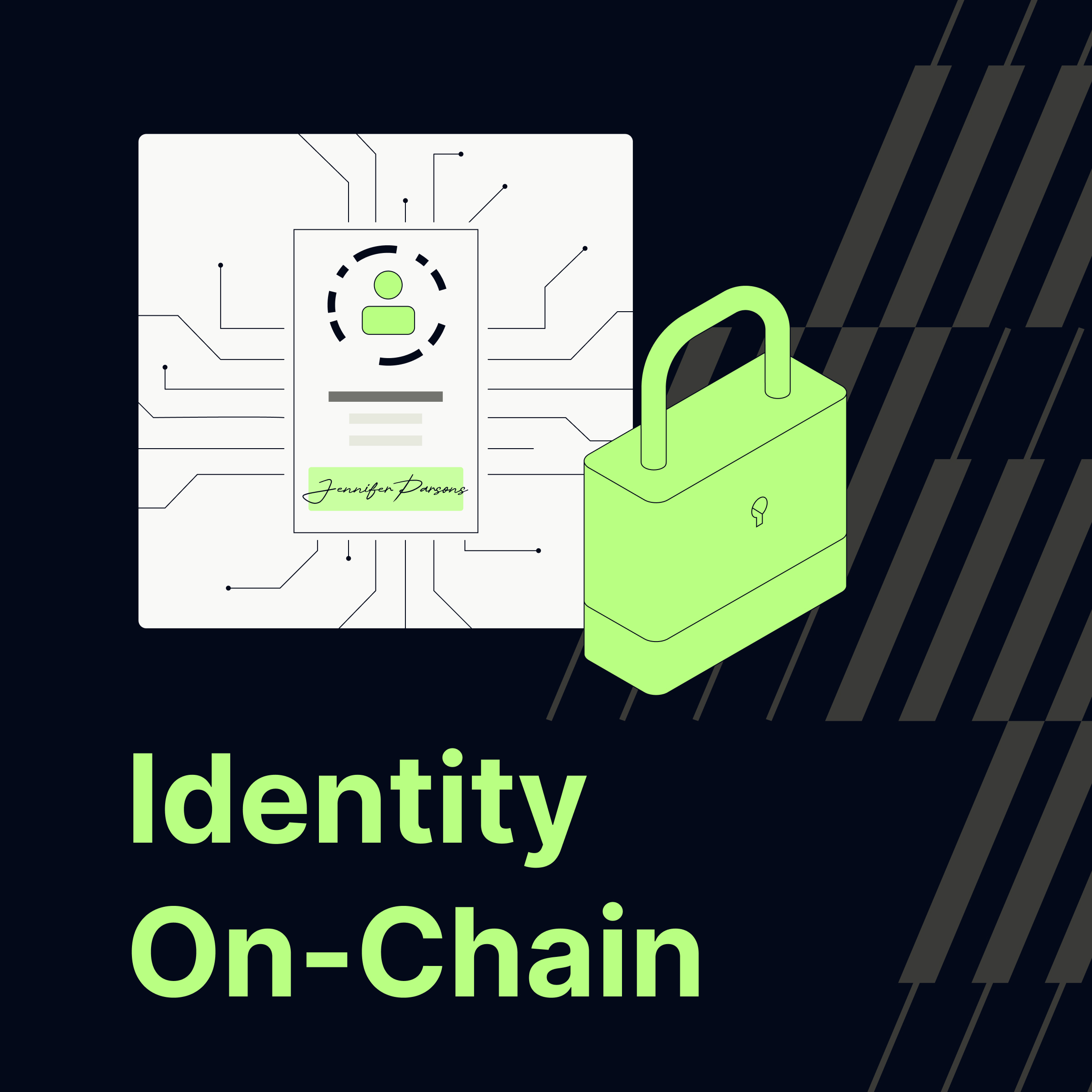
The phrase itself can sound loaded. For some, it raises concerns about surveillance and the loss of pseudonymity. For others, it promises a path toward clearer accountability and broader institutional trust. The reality is more nuanced. Identity on-chain is not about rewriting the rules or exposing personal data on public ledgers. It is about exploring how cryptographically verifiable identity signals could make existing compliance requirements more efficient, defensible, and interoperable across institutions.
To understand the opportunity, it helps to start by clearing up a few common misconceptions.
Key takeaways
- Identity crypto, when framed as verifiable compliance infrastructure rather than surveillance, gives exchanges, VASPs, and banks a way to reduce redundant KYC checks without expanding what regulators require.
- The crypto Travel Rule, the traditional BSA Travel Rule, and enhanced due diligence are three distinct frameworks that are frequently conflated; understanding the difference determines which identity tools actually solve your compliance problem.
- Zero-knowledge proofs allow users to demonstrate specific attributes — such as not appearing on a sanctions list — without disclosing their full identity, making privacy-preserving compliance technically achievable for self-hosted wallets.
- The market is moving in two parallel directions simultaneously: privacy-focused pseudonymous protocols and permissioned, KYC-gated institutional models — and the most resilient identity infrastructure will need to support both.
- Digital credentials, whitelisted wallet logic, and ZK-based attestations are not silver bullets, but they are the most promising components of a scalable, principled trust architecture for the next phase of crypto.
We are not creating new rules. We are making existing ones work better.
One of the most persistent misunderstandings in crypto policy discussions is the idea that new technical approaches are attempts to invent new regulatory frameworks. In practice, the opposite is often true.
Most proposals around identity on-chain are not trying to replace regulations like the Bank Secrecy Act or the Travel Rule. They are responding to a simpler problem: compliance today is expensive, fragmented, and operationally brittle. Institutions repeatedly collect and verify the same information, pass it through disconnected systems, and rely on manual reviews that do not scale well as transaction volumes increase.
The opportunity is not to change what data is required, but to change how that data is attested, shared, and verified. Cryptographically signed identity metadata and digital credentials offer one way to do that. They can make compliance faster and cheaper while improving data integrity and auditability, all without expanding the scope of what regulators require.
Framed correctly, identity on-chain is not about adding friction. It is about reducing it.
Untangling the travel rule confusion
Another challenge in this space is that several distinct regulatory concepts are often blended together, leading to unnecessary fear and complexity.
At a high level, there are three separate frameworks at play:
1. The traditional travel rule under the BSA
This rule applies to fiat wire transfers above certain thresholds, and is the rule banks have followed for decades, requiring information like sender name, address, and account details.
2. The crypto travel rule
This rule applies when value is transferred between virtual asset service providers. In the eyes of regulators, these providers function as money services businesses, so the obligations largely mirror those in the fiat world.
3. Enhanced due diligence
This includes additional reviews banks or institutions may perform based on risk, such as asking about source of funds or transaction history. While important, EDD is not the same thing as the Travel Rule, even though the two are often conflated.
Why does this matter? Because when banks request wallet histories or blockchain data, they are typically doing so as part of EDD, not because the Travel Rule requires on-chain transparency. Understanding this distinction opens the door to better solutions. Digital identity credentials can improve the fidelity of required data across all three frameworks without forcing blockchain activity into places it does not belong.
Where digital identity can actually add value
When applied thoughtfully, digital identity infrastructure has the potential to streamline compliance across several common crypto workflows.
In VASP to VASP transactions: verifiable identity credentials could be embedded into existing messaging standards. This would reduce the need for repeated KYC checks and lower fraud exposure by allowing counterparties to trust previously verified attributes.
In VASP to bank flows: signed supplemental identity packets could accompany traditional wire messages. These might include verification timestamps or risk indicators that help banks resolve false positives more quickly and reduce delays tied to sanctions screening.
For source of funds inquiries: structured attestations could replace ad hoc document requests. Instead of relying exclusively on blockchain forensics, an institution could present a verifiable claim such as trading gains over a defined period, backed by cryptographic proof.
None of these approaches introduce new regulatory requirements. They focus on reducing redundancy and improving trust between institutions that already have obligations to one another.
Preserving pseudonymity for self hosted wallets
Perhaps the most sensitive area in this discussion involves self hosted wallets. These wallets are not financial institutions, and they are not subject to the same regulatory expectations as centralized intermediaries. Attempting to impose direct KYC requirements on them is neither legally sound nor technically feasible.
This is where more advanced privacy preserving techniques come into play. Zero knowledge proofs offer a way for users to demonstrate specific attributes without revealing their full identity. For example, a user could prove they are not on a sanctions list or that a transaction falls below a regulatory threshold without disclosing who they are.
This approach aligns with a key reality of the crypto ecosystem. Most participants have completed KYC at some point to enter or exit the system. The question is not whether identity exists, but how selectively it can be disclosed. ZK based identity proofs provide a path toward compliance that respects privacy and maintains alignment with industry values.
Signals from the market Are pointing in two directions
The market itself is already experimenting with these ideas, often in parallel.
On one side, privacy focused protocols are gaining traction. Developers and users are increasingly comfortable with pseudonymous identity models that rely on cryptographic assurances rather than centralized databases.
On the other side, institutions are adopting permissioned models. Large asset managers have launched funds that restrict transfers to KYC verified wallets only. This reflects a different set of expectations around risk, custody, and regulatory accountability.
These trends are not mutually exclusive. In fact, they suggest a future where programmable permissioning and selective disclosure coexist. The most resilient identity infrastructure will likely be flexible enough to support both.
The long term opportunity in crypto is not to recreate surveillance systems from traditional finance. It is to reduce the cost and complexity of compliance while preserving what makes the technology powerful.
Identity on-chain, when approached as verifiable compliance rather than de anonymization, can help bridge the gap between regulators and innovators. Digital credentials, whitelisted wallet logic, and zero knowledge proofs are not silver bullets, but they are promising components of a more scalable and principled trust architecture.
At Proof, we think deeply about how identity can move across systems with integrity, privacy, and accountability. Whether in crypto, financial services, or regulated digital transactions more broadly, the goal is the same: make trust portable, verifiable, and usable without unnecessary friction.
If you are exploring how digital identity can support compliant growth in crypto or beyond, we would love to continue the conversation.
Get in touch with Proof to learn how verifiable identity can help you build trust at scale >



















































.jpg)
























































.jpg)