Why Power of Attorney Documents Stall Real Estate Closings (And How to Fix It)


Updated August 11, 2026
A power of attorney for real estate closings is one of the most useful legal tools in a title professional's toolkit. It is also one of the most reliable sources of delay, rejected documents, and last-minute deal failures. Ask any escrow officer where digital closings still break down, and the answer comes back the same way, almost every time: Power of Attorney forms.
This article explains why that happens, what the specific failure points are, and how digital POA workflows resolve both the fraud risk and the operational friction that manual processes create.
Key takeaways
- A power of attorney (POA) for a real estate closing authorizes one person to sign documents, transfer title, and handle financial transactions on behalf of another. It is legally valid only when it meets state-specific execution requirements, including proper notarization, correct language, and in many states, recording with the county.
- POA problems at closing fall into two categories: fraud risk and workflow failure. Both can stop a deal. Forged signatures, impersonators, and outdated authority are fraud concerns. Missing notarization, wrong document type, and no audit trail are workflow failures.
- Lender and title company approval is required before a POA can be used at closing. Most lenders have strict, and sometimes unpublished, requirements. Submitting the POA early, often weeks before closing, is the single most effective way to prevent last-minute rejection.
- Digital POA workflows, using biometric identity verification, remote notarization, and tamper-evident audit trails, reduce manual handoffs, close fraud exposure gaps, and give title teams a defensible record for every transaction.
What is a power of attorney in real estate?
A power of attorney is a legal document that authorizes one person, called the agent or attorney-in-fact, to act on behalf of another person, called the principal. In a real estate context, the agent can sign closing documents, transfer title, execute mortgage agreements, accept funds, and take any action necessary to complete the transaction.
POAs come into play when a seller is overseas, a spouse is unavailable, a signer is incapacitated, or a trusted representative needs to act on someone's behalf during a military deployment or medical situation. They are designed to keep transactions moving when the principal cannot be present.
In practice, they often do the opposite.
Types of POA used at real estate closings
Not every POA is appropriate for a real estate closing. The type matters, and using the wrong one is one of the most common reasons a document gets rejected.
- Limited or special POA: Authorizes the agent to handle a specific transaction, often tied to the property's legal description. This is the most commonly accepted type for real estate closings.
- Durable POA: Remains valid even if the principal becomes incapacitated. In some states, a durable POA is required when the principal has a medical condition that may affect their capacity.
- Springing POA: Only takes effect under specific conditions, such as incapacitation. Most title companies and lenders will not accept a springing POA because verifying that the triggering condition has been met is too complex and creates liability.
Why POAs stall digital closings
Title teams today process dozens of transactions a day using eClosing tools, remote signings, and integrated platforms. Then a POA enters the workflow, and the pace drops to manual.
Printing, scanning, overnighting, scheduling notaries, manually checking signatures, verifying state requirements: these steps are not compatible with digital closing speed. One missing detail, one mismatched state requirement, one signature that does not match the name on the document, and the entire deal stalls.
A single POA can delay a cash deal. It can hold up seller-side funding. It can force a team to chase paperwork and push a closing back by days or weeks.
In a market where clients expect to sign documents on their phones, that kind of friction creates doubt, and doubt costs deals.
Risks and red flags: why POAs get rejected
POA problems at closing fall into two categories. Both can stop a deal.
Fraud risks include:
- Forged signatures on the POA document itself
- Impersonators posing as the principal or the agent
- Outdated POAs used after authority has been revoked
- Agents acting outside the scope of what was granted
Workflow failures include:
- Missing or incorrect notarization
- Forms that do not meet state-specific or lender requirements
- The wrong type of POA used for the transaction
- No audit trail to confirm identity or timing
- Last-minute submission that does not allow time for review
The CFPB warns that spotting a forged POA document is one of the key defenses against abuse. Title companies increasingly scrutinize POAs because impersonation fraud is rising. A document that looks correct on its face may still carry identity risk if the principal's identity was never verified against a government-issued credential.
Certain circumstances raise red flags with underwriters and lenders:
- An agent who has a financial interest in the transaction
- A POA executed at the last minute with no clear explanation
- A POA executed out of state without compliant formalities for the state where the property is located
How to use a power of attorney at closing: step by step
If a POA is the right path, preparation and timing determine whether it works.
- Start early. Do not wait until the week of closing. POA review takes time, and corrections after execution may require re-signing.
- Draft a legally compliant document. Use language that specifically authorizes the agent to execute all documents necessary to complete the transaction. Tie the POA to the property's legal description.
- Execute correctly. Sign in the presence of two witnesses and a notary. Confirm the state's specific requirements before signing.
- Submit to the title company and lender for review. Get written approval before closing day. Ask whether the lender requires their own form.
- Record the POA. In most states, the original or a certified copy must be recorded with the county where the property is located.
- Provide copies to all parties. The title company, lender, real estate agent, and the agent acting under the POA all need copies.
- Maintain oversight. Even if you are not present at closing, stay in contact with your agent and attorney throughout the process.
On closing day, the agent signs all documents on the principal's behalf. Every signature must reflect that the agent is acting under a POA, for example: "Jane Smith, as Attorney-in-Fact for John Doe." This format confirms the legal validity of the documents and avoids confusion about authority.
How digital POA workflows close the gap
When a POA is genuinely necessary, digital workflows address both the fraud risk and the operational friction that manual processes create.
With Proof, title teams can:
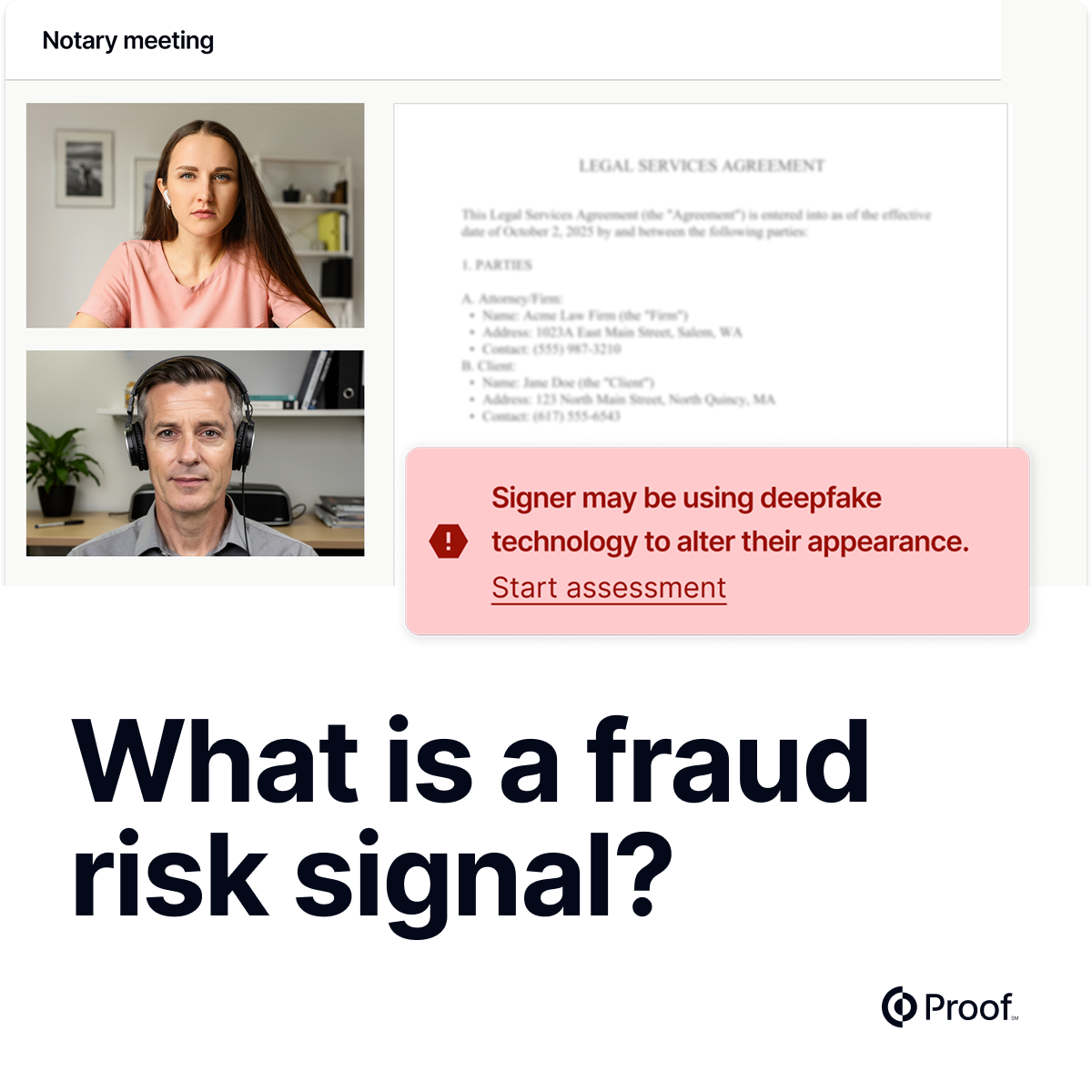
- Verify signer identity upfront using facial biometrics, credential analysis, and real-time fraud signals
- Complete and notarize POA documents remotely, in minutes, with 24/7 notary availability
- Monitor progress, route forms, and access completed documents instantly
- Maintain a secure audit trail that meets compliance standards and can withstand legal challenge
Every step is documented. Every identity check is recorded. The completed POA is securely archived and immediately accessible to all parties. Your closers can focus on the closing experience rather than chasing paperwork and manually verifying signatures.
Proof has facilitated more than $640 billion in real estate transactions. The platform enforces more than 4.5 million compliance rules automatically, covering state RON standards, underwriter requirements, and lender policies, so title teams do not have to track those requirements manually.
What title teams need to move faster with less risk
Your closers already know how to spot a problem POA. They understand what an enforceable document looks like. The problem is the manual steps that slow them down and leave too much room for error.
Digital POA workflows replace those manual steps with a verified, auditable process. Identity is confirmed before the document is executed. Notarization happens remotely, in minutes. The completed document is immediately accessible and archived. Every step produces a record that can withstand scrutiny.
That is the difference between a closing that moves at digital speed and one that stalls on a single piece of paper.
Watch the on-demand webinar to see exactly how digital POAs move through a verified, notarized workflow, from identity check to audit-ready close.


































.jpg)










































.jpg)