How Credit Unions Can Fix Their POA Workflow


Updated August 11, 2026
Credit unions are built on trust. Today, that trust is tested by friction just as much as by fraud.
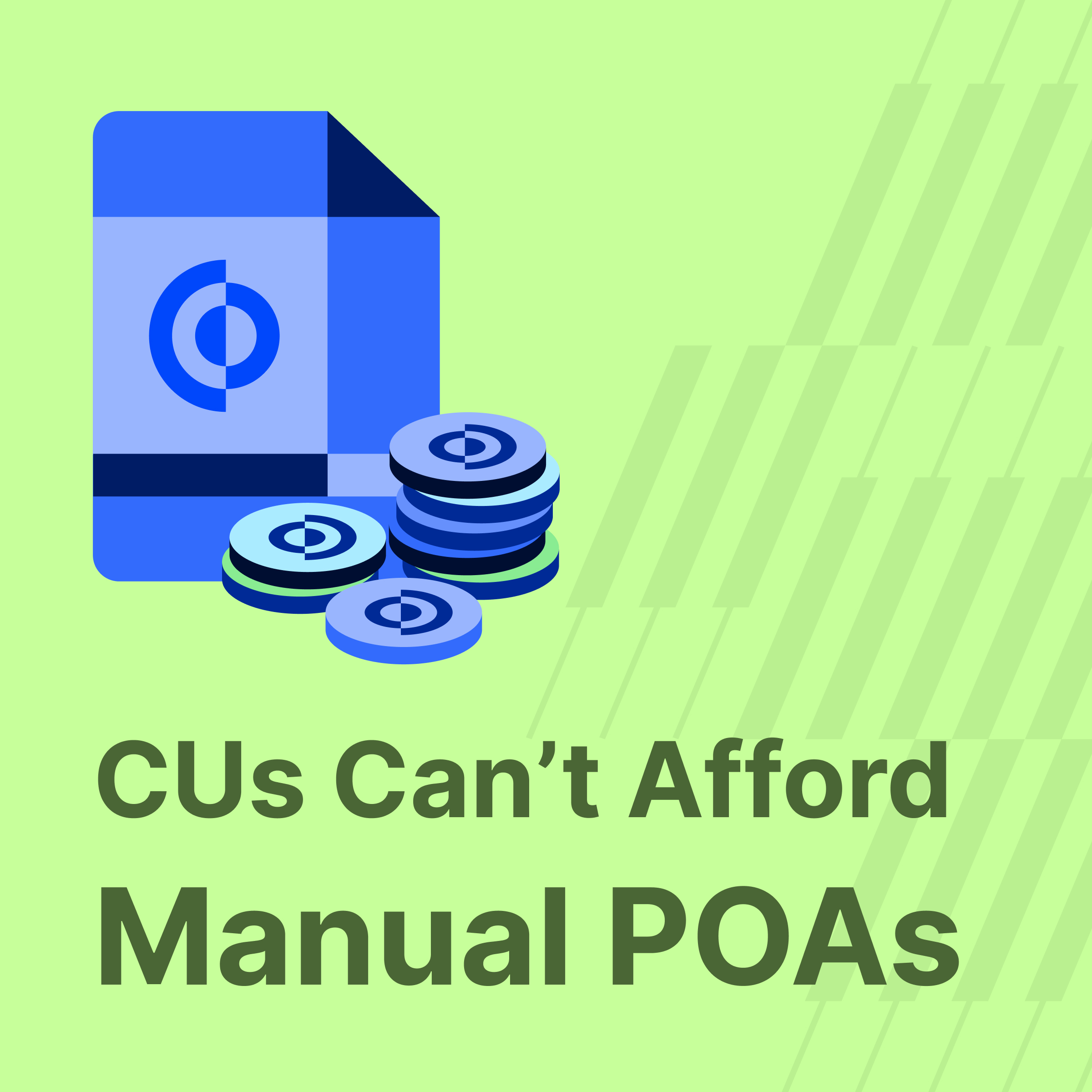
Power of attorney (POA) documents show up at some of the most consequential moments in a member's financial life: managing a spouse’'s finances, helping aging parents, or stepping in during deployment or illness. For many credit unions, the credit union POA workflow is still manual, paper-based, error-prone, and slow. That creates a bottleneck. Members wait. Staff get overwhelmed. The cost is measured in time, dropped applications, and eroding member loyalty.
Fixing the credit union POA workflow reduces fraud risk and improves the entire member experience. Here is why manual processes are holding credit unions back, and how leading institutions are digitizing the process to serve members faster and more securely.
Key takeaways
- Manual POA workflows fail at the structural level: paper forms, visual signature checks, and branch-dependent notarization create delays and compliance gaps that no amount of staff diligence can fully close.
- One in five credit union members now logs into a mobile app daily, surpassing total branch foot traffic. Routing those members back to a branch for POA notarization is a service gap that competitors will exploit.
- A digital POA workflow verifies signer identity before anything is signed, executes notarization remotely, creates a tamper-proof audit trail, and routes completed documents instantly to the credit union's system of record.
- Proof saves credit unions an average of more than $110 per loan compared to a paper-based process, with measurable reductions in rework, escalations, and overnight shipping costs.
Why POA workflows break down at credit unions
POA workflows fail at the structural level, independent of how diligent the staff reviewing them are. A notary certification that does not meet state requirements, a missing witness signature, a form that is technically valid but outside the institution's accepted format: any one of these means the document gets kicked back.
Because most of that review happens after the document has already traveled through mail, fax, or a branch visit, the delay is baked in from the start. The current process was built for a branch-first world, and it shows:
- Paper forms must be mailed, scanned, or hand-delivered
- Staff must visually review signatures and dates
- Notary appointments require scheduling and follow-up
- Errors lead to rework, delays, and frustrated members
The compliance exposure compounds the operational drag. Credit unions bear real liability when they act on a POA that turns out to be forged, improperly executed, or used by someone acting outside the scope of what the principal authorized. Paper documents offer no real chain of custody. There is no way to confirm the signer's identity after the fact, no way to prove the notary verified who was in the room, and no clear audit trail if a dispute arises.
POA fraud and elder financial abuse are documented and growing problems across financial institutions. A document that is easy to forge and hard to verify is a vulnerability by definition.
What manual POA processing actually costs
POAs may be infrequent, but when they go wrong, the downstream impact is significant:
- Slower service. Members cannot wait days for a POA to be signed, notarized, and verified, especially when they are authorizing urgent action on a loan, account, or estate.
- Rework and resource strain. Incomplete forms, missing signatures, and notary mistakes require staff to follow up, resubmit, and redo. That wastes time and energy your team does not have.
- Member drop-off. When the POA process gets clunky, some members simply stop. Whether it is a loan that does not fund or a caregiver who gives up on getting access, your institution pays the price.
- Fraud exposure. Manual POAs leave gaps for forged signatures, outdated authority, and coercion. When your review process relies on visual checks alone, it is easy to miss what matters.
The operational math is concrete. Proof's platform saves credit unions an average of more than $110 per loan compared to a paper-based process. Factor in staff hours freed from manual document review, the reduction in escalations and rework, and the elimination of overnight shipping costs for wet-signed documents, and the return on investment case is clear.
There is also a harder-to-quantify cost: the member relationships you do not lose. A member who walks away because your POA process failed them at a critical moment rarely tells you that is why they left.
What a modern credit union POA workflow looks like
A digital POA workflow has four core components. Each one closes a gap that paper processes leave open.
Step 1: Verify identity before anything is signed.
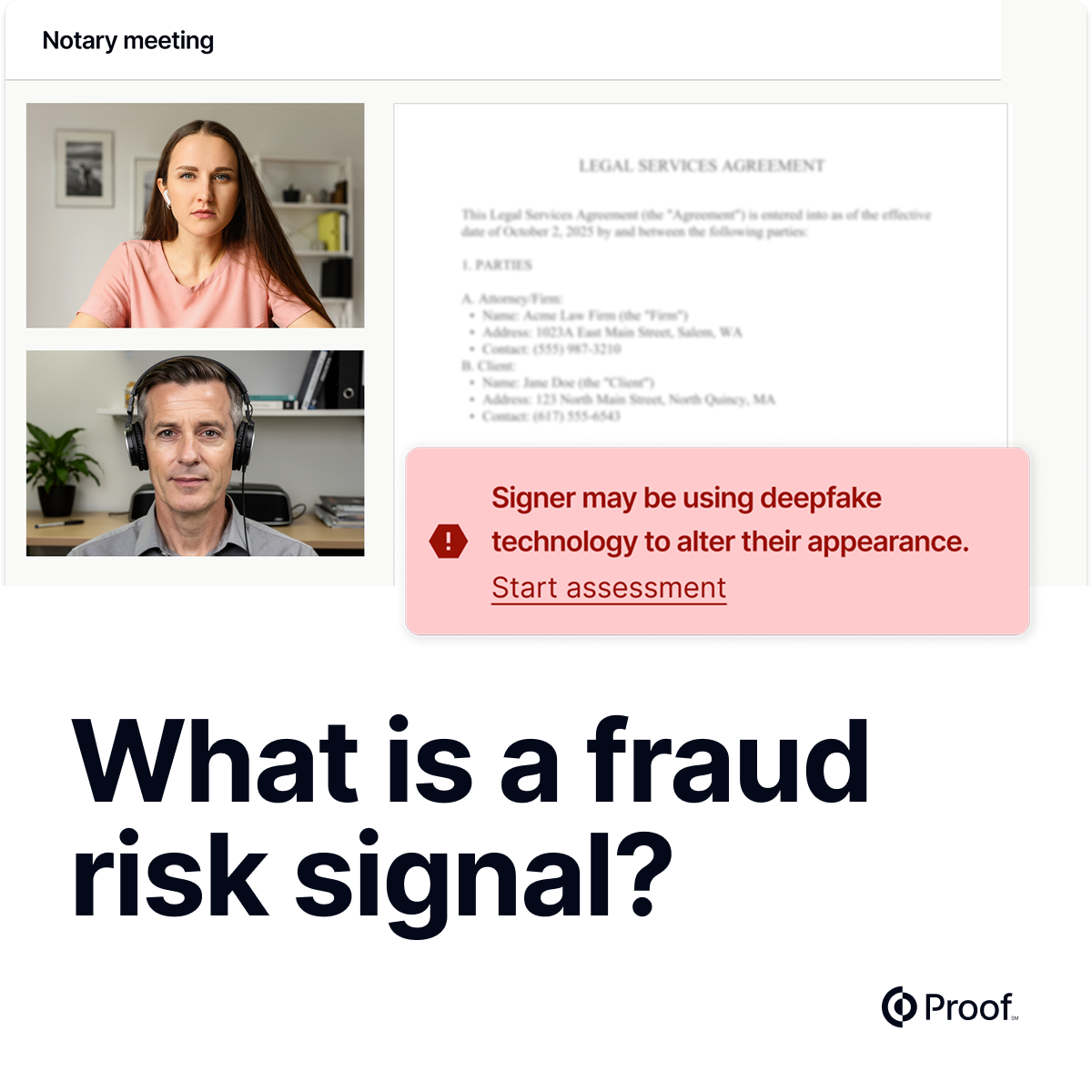
Every signer is authenticated through government ID analysis, biometric facial recognition, knowledge-based authentication (KBA), SMS verification, and real-time fraud scoring. These checks happen before the member ever sees the document. Proof's NIST IAL2-compliant checks match biometric data to government IDs in real time, with automated fraud signals that flag suspicious behavior before a document is finalized. That is a meaningfully higher bar than what a branch visit or a mailed document can provide.
Step 2: Execute notarization remotely.
Remote online notarization (RON) is legal in 49 states and the District of Columbia as of 2026. Members can access Proof's on-demand network of credentialed notaries 24 hours a day, seven days a week, or credit unions can use their own in-house notaries with overflow to the network. No branch visit required. No scheduling delays.
Step 3: Create a tamper-proof audit trail.
Every step is time-stamped and sealed into an audit trail that stands up to legal and regulatory scrutiny. Proof embeds state-specific notary requirements, identity verification, and document validation into the process itself. That means no missed fields, no invalid signatures, and no guesswork about what is legally sufficient when auditors come calling.
Step 4: Route completed documents instantly.
In a paper-based process, a completed POA still has to be scanned, emailed, or physically delivered to the credit union before anyone can act on it. In a digital workflow, the moment a document is signed and notarized, it is already where it needs to be. All transactions are automatically archived and audit-ready. Staff can monitor progress, access documents, and route them internally without rework.
Members can complete POAs in under six minutes, often from their phone. No app download required.
How credit unions are solving this today
Baxter Credit Union, named to the Forbes Best-in-State Credit Unions list, faced exactly this challenge with their consumer loan servicing team. They were considering sending mobile notaries to members' homes to make the notarization process easier. Then they discovered it could be done entirely online.
"Since then, Proof has helped reduce a process in paper that took days to complete, to an average of 15 minutes that gets sent right to our system," said Allison Yaney, Supervisor of Consumer Loan Servicing and Consumer Titles at Baxter Credit Union. "It couldn't be easier."
The difference between days and 15 minutes is a fundamentally different experience for the member and a fundamentally different operational reality for the credit union's staff.
Where to start with digitizing your POA process
If your credit union is still routing POA requests through a paper-based process, the first step is understanding where the friction actually lives. Ask your team:
- How many POA documents come back with errors?
- How long does the average POA take from initial request to completed record?
- What percentage of those transactions require a branch visit?
The answers tend to make the case for change on their own.
Digitizing the POA process does not mean replacing people. It means empowering them. It means turning a manual, error-prone task into a secure, guided workflow that reduces review time, eliminates confusion, and gives members the service they expect.
With Proof, you can transform the POA workflow from a risk point into a relationship builder. Implementation takes days, not months.
Want to see how other credit unions are turning POAs from a hassle into a high-impact member experience? Watch the on-demand webinar with industry experts and a real-time demo of digital POAs in action.
































.jpg)




































.jpg)