How Online Car Dealerships Can Use Verified eSign


Updated June 1, 2026
Online car buying is a fraud magnet, and most dealerships aren't ready. Every document signed remotely, every financing application submitted from a phone, and every out-of-state deal is a window for identity spoofing and signature forgery. As the car-buying journey goes fully digital, the exposure grows with it. Verified eSignatures are how dealers close that gap, ensuring document authenticity, signer identity, and legal compliance in a single workflow.
Verified eSignatures offer more than convenience: they connect identity, intent, and the signature event itself, giving dealers a defensible record at every step. Here's how car dealerships can use verified eSignatures to close deals securely and keep fraud out of every transaction.
Key takeaways
- Fraud prevention: Verified eSignatures link identity, documents, and signatures through layered verification to prevent impersonation and unauthorized signing.
- Consumer demand: Today's car buyers expect to research, finance, and sign from their phones. Verified eSignatures meet that expectation, delivering speed and security without a trip to the dealership.
- Faster funding: Layered identity verification, including knowledge-based authentication and biometric checks, accelerates the financing and insurance approval process.
- Legal compliance: Verified processes ensure signatures are attributable to the intended signee, meeting state-level requirements for auto documents.
Strengthen security with verified eSignatures
The primary benefit of verified eSignatures is certainty: dealers know who signed, what they signed, and that the document hasn't been altered after the fact.
Standard eSignatures carry similar risks to wet-ink signatures. Without robust security in place, dealerships face several identity-related threats across their digital transaction workflows.
Fraud threats targeting online dealerships
Common tactics
- Identity theft and spoofed buyer credentials used to initiate financing applications or purchase agreements
- Unauthorized signing, where one individual submits a signature on behalf of another without legal consent
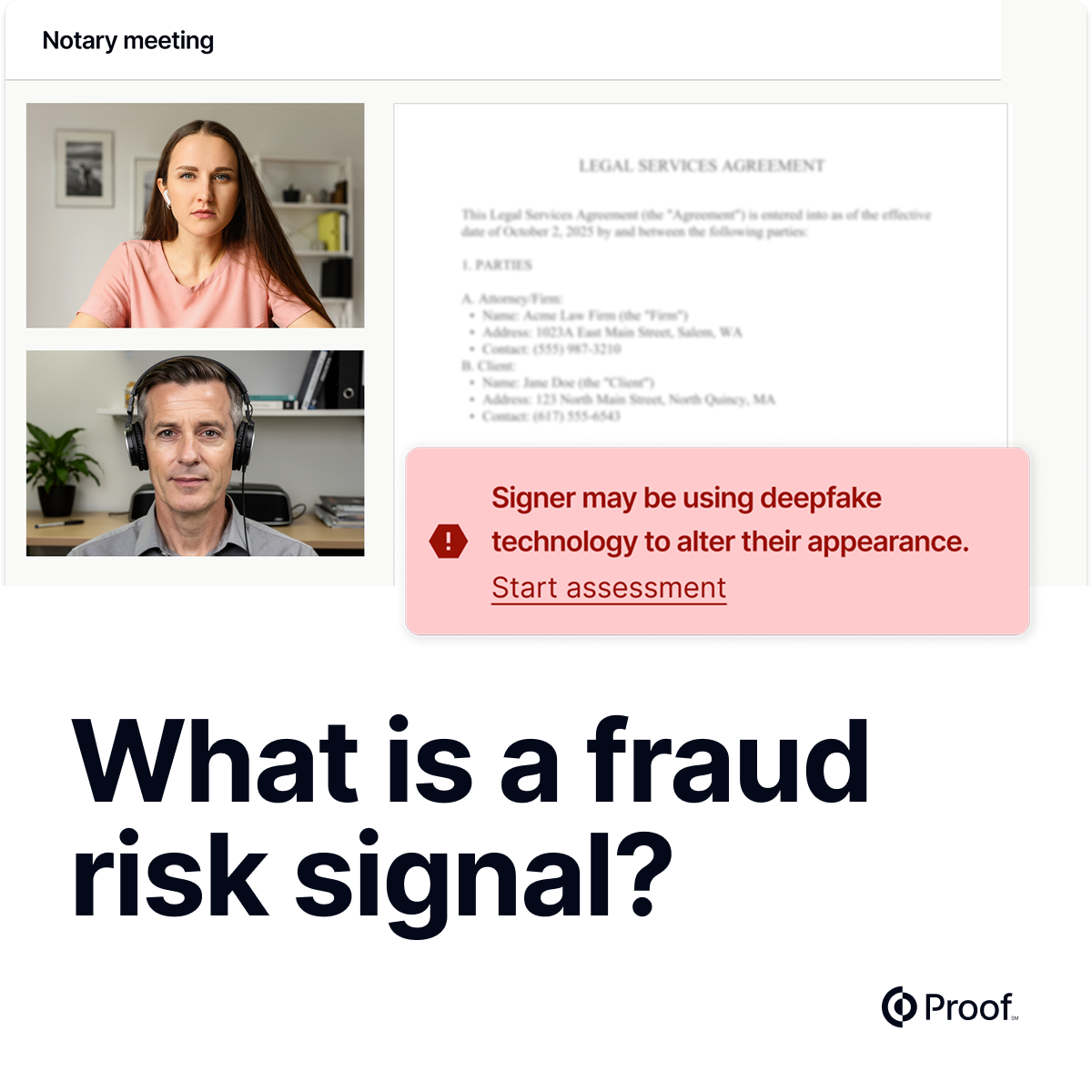
- AI-generated deepfakes impersonating real buyers during remote identity checks
- Synthetic identities constructed from stolen data, passing surface-level verification
- Falsified supporting documents, including pay stubs, driver's licenses, and insurance cards
What you can do
- Require layered identity verification before any signature is accepted, including credential analysis and knowledge-based authentication
- Add biometric verification with liveness detection to confirm the signer is physically present and not AI-generated
- Use a platform like Proof Defend that monitors for AI-generated fraud signals in real time across transaction channels
- Ensure every transaction produces a cryptographic audit trail linking confirmed identity, document version, and signature event
Many states that allow eSignatures on auto documents require that they are attributable to the intended signee. That means dealers need more than a mark on a screen: they need a provable connection between the signer's identity, the document, and the signature event itself.
The verified eSignature process confirms signer identity and produces a complete digital audit trail, including timestamps, authentication results, and tamper-detection checks, so dealers can prove that the right person signed the right document and that nothing changed after the fact.
On the Proof platform, dealers send eSign requests directly from their business portal. Before a signer can apply their signature, they must pass layered identity checks, including credential analysis, knowledge-based authentication, and biometric verification, producing a documented audit trail tied to a confirmed identity.
How verified eSignatures speed up funding
One of the greatest opportunities for growth in the auto space is around funding and insurance. A Digitization of End-to-End Retailing study by Cox Automotive found that buyers prefer completing the following steps online:
- Applying for credit and financing
- Receiving notification of financing qualifications
- Selecting preferred financing and insurance products
In the paper world, applying for funding and receiving approval can take days. Meanwhile, online platforms already offer financing decisions and trade-in valuations in minutes. Dealers still relying on manual workflows aren't just slow: they're losing deals to competitors who have already gone digital. Every verified eSignature produces a structured, traceable record that lenders can review immediately, eliminating the back-and-forth document requests that stall funding timelines.
The result: dealers and their lender partners can make funding decisions with confidence, because every signature is backed by a verified identity and a defensible audit trail.
Build the trust buyers already demand
Beyond the business benefits, signers have come to expect the convenience of eSignatures. Consumer comfort with signing digitally is now mainstream, and that familiarity extends to major financial decisions like car purchases. Buyer satisfaction with the overall shopping experience has climbed steadily as dealerships reduce the time customers spend on paperwork. A more efficient purchase process, one that doesn't require hours at a desk, drives better outcomes for everyone involved.
The regulatory environment is already moving in dealers' favor, and the dealerships building verified eSign into their workflows now will be positioned to move faster as state adoption of eSignature legislation continues to accelerate. Dealers who act now will own the trust advantage.
When dealers embed verified identity and RON into their workflows, they close faster, fund with confidence, and lock fraud out of the process from start to finish. See how Proof secures every signature, document, and identity in your dealership's digital workflow. Schedule a demo.
























.jpg)






































.jpg)