How digital transactions could have prevented the Graceland sale fraud scheme


Updated August 20, 2026
Key takeaways
- Deed fraud succeeds at the county recording step because forged documents can be recorded without any authentication check. The Graceland scheme exploited this gap directly.
- A digital notarization with a cryptographic certificate would have made the forgery immediately detectable. Any recipient could have opened the PDF, checked the certificate, and confirmed the document was never legitimately notarized.
- Remote online notarization (RON) requires knowledge-based authentication, credential analysis, and live notary review. A fraudster impersonating a deceased person cannot pass all three.
- The Graceland case is not an outlier. Experts cited by the Associated Press confirmed that fraudulent claims targeting the assets of elderly or deceased people arise far more often than the public realizes.
Deed fraud, also known as home title theft, is one of the fastest-growing threats in real estate. It works like this: a fraudster forges documents to record a phony transfer of property ownership, then sells the home, takes out a mortgage against it, or rents it out for profit. It can happen to anyone who owns property, but the elderly, distressed homeowners, and unwitting buyers are hit hardest.
The attempted foreclosure sale of Elvis Presley's Graceland compound made international headlines, and it's a textbook example of how this scheme unfolds. Elvis Presley's granddaughter, actress Riley Keough, who controls the family trust, filed a lawsuit to stop a planned foreclosure sale of the famous Graceland compound. She alleged that the purported sale involves deed fraud based on forged documents and a fake notarization. The story drew coverage from The New York Times, the Wall Street Journal, NPR, BBC, and many other outlets.
Keough alleged that Naussany Investments & Private Lending LLC not only forged documents leading to the sale, but that Naussany doesn't even exist. Naussany Investments claimed that Keough's mother, Elvis's daughter Lisa Marie Presley who died in 2023, had borrowed $3.8 million from the company and gave a deed of trust, putting Graceland up as collateral for the loan.
Court documents filed by Keough alleged that Naussany "appears to be a false entity" and that the documents it presented about the loan were also fake. Additionally, Keough maintained that the promissory note and deed of trust, both of which appear to bear the signature of Lisa Marie Presley and to have been notarized in Florida in 2018, are both fraudulent. The notary in question even signed an affidavit swearing to the fact that she has never notarized a document for Lisa Marie.
Deed fraud doesn't just threaten celebrities. It's a threat hiding in ordinary real estate transactions every day. The Graceland case exposed what forged documents and a fake notarization can do. Here's how digital identity proofing and remote online notarization would have stopped it.
How would a digital certificate help prevent forged notarizations?
A digital notarization shows that the document has been sealed by the notary's digital certificate. That's the equivalent of the notary putting their stamp on the document, but digitally. This certificate acts as a tamper seal for notarized documents, preserving the document's integrity post-notarization. That digital certificate is unique to every notary and is only assigned after a notary has verified their identity. Applying a digital certificate to a document cryptographically associates the notary's identity to the document, acts as a digital lock, and makes it tamper-proof after the transaction has ended.
Recipients such as the auction company or Keough's lawyers could easily inspect the certificate properties or review audit trails to verify when the document was completed, by whom, and that it had not been modified after the notarization.
Deed fraud most often succeeds at the county recording step, because forged deeds can be recorded without any authentication check. That's exactly the gap a digital certificate closes. Any recipient, whether a title company, auction house, or attorney, could have spotted the forgery immediately:
- Open and inspect the PDF. If the document does not contain a valid digital signature generated by the notary, the forgery is immediately apparent.
- Check for a cryptographic seal. A legitimately notarized document carries a tamper-evident cryptographic seal. Its absence confirms the document was never properly notarized.
- Verify certificate properties and audit trail. Inspecting the certificate properties reveals exactly when the document was notarized, by which notary, and confirms that the document has not been modified since.
Proof digital certificates were created to solve the exact problem illustrated by the Graceland case. Digital transactions are much safer than paper for all of the reasons stated above, and Proof's digital certificates have set the new platinum standard for enhanced security in notarized transactions.
Proof Digital Certificates have been fully audited against WebTrust standards and are included on the Adobe Authorized Trust List (AATL). Documents sealed with a Proof Digital Certificate also include a visible green checkmark in the digital file, providing instant assurance of integrity and auditability. That green checkmark reduces the risk of rejection by businesses, banks, and government agencies.
How could remote online notarization have helped?
Identity proofing the signer
If Lisa Marie or an impersonator attempted to notarize these documents through remote online notarization (RON), robust identity verification designed to stop fraud would have prevented someone from completing the transaction if they weren't who they claimed to be.
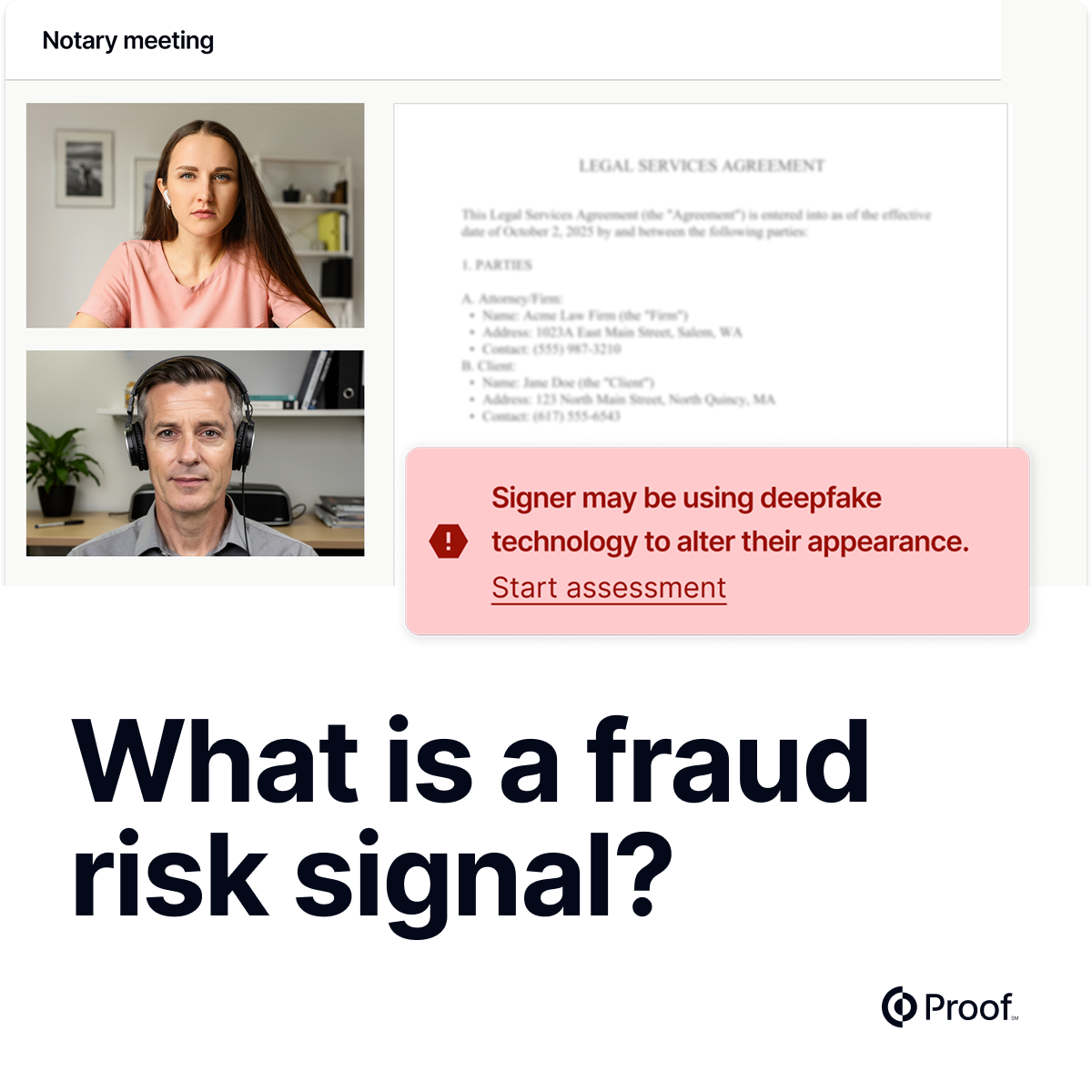
RON requires multi-step identity verification, going well beyond an in-person visual check of a government-issued ID. For an online notarization, identity verification begins with knowledge-based authentication questions. Then, a signer completes credential analysis, which checks the authenticity of their government-issued ID. Finally, a notary public completes a manual review, comparing the results and photo ID with the person appearing before them.
Evidence of the transaction
As the Graceland situation demonstrates, when a paper notarization is called into question, very little information may be available to confirm its authenticity. Outside of a written journal, the notary's memory may be the only other available evidence to help in a fraud investigation. Unlike paper notarizations, online notarization creates a detailed and connected trail of evidence, making it difficult for a fraudster to slip away as if nothing ever happened.
Online notarization produces an end-to-end video recording of the signing session, showing what the signer and the notary looked and sounded like at the time of the notarization. In the case of Graceland, Keough's lawyers or the court could have requested a copy of that video to determine if Lisa Marie ever appeared before the notary. Paper provides little, if any, insight into the lifecycle of a document. With a paper notarization, there's minimal evidence to tell you whether the notary's stamp is legitimate. You'd have to track down that notary and ask them to produce evidence. Online notarization platforms like Proof provide a comprehensive audit trail that reflects every action the signer took on the platform.
Verified notaries
Online notarization platforms also have onboarding processes that take the necessary precautions to connect customers to a notary they can trust. At Proof, our team reviews each notary on our platform to ensure the notary has the proper commission, insurance, and state approvals to complete notarizations online. Additionally, notaries on the Notarize Network must obtain Notary Signing Agent (NSA) Certification through the National Notary Association. The NSA Certification process includes a background check and must be completed annually.
How can I protect myself from deed fraud?
The most effective steps are monitoring your property records regularly, signing up for title monitoring services if available in your county, and using platforms with robust identity verification for any real estate transaction. When documents need to be notarized, remote online notarization with platforms like Proof creates a cryptographic audit trail and video recording that provide strong evidence in the event a transaction is ever challenged.































.jpg)








































.jpg)