The Future of Digital Identity


Updated September 15, 2026
Digital identity is the foundation of every online interaction. It determines who gets access, who gets trusted, and who gets stopped. As more of commerce, healthcare, finance, and government moves online, the stakes attached to getting identity right have never been higher.
This post covers where digital identity came from, what's reshaping it now, and what organizations operating in regulated or high-stakes digital workflows should prepare for next.
Key takeaways
- Digital identity is a persistent set of verified attributes, credentials, and behavioral signals that systems use to confirm who is acting and whether that action is authorized.
- Fraud pressure, privacy regulation, and the collapse of password-based authentication are the three forces most actively reshaping how organizations approach identity today.
- Passwordless authentication is accelerating: organizations that delay the transition leave credential-based attack surfaces open that are well-documented and actively exploited.
- Privacy legislation is no longer a future concern. More than two dozen U.S. states have introduced or passed data privacy laws, and the regulatory floor is rising.
- AI-generated threats including deepfakes, synthetic identities, and injection attacks have changed the threat model. Point-in-time verification is no longer sufficient for high-value workflows.
- Organizations that treat identity as infrastructure rather than a compliance checkbox are better positioned to prevent fraud, meet regulatory requirements, and build durable customer trust.
What is digital identity?
A digital identity is the collection of data a system uses to represent and verify a person, organization, device, or application online. It is how a bank confirms the person requesting a wire transfer is the account holder. It is how a title company confirms the seller signing a deed is who they claim to be. It is how an employer confirms the candidate in a video interview is the same person whose credentials were submitted.
Digital identity is composed of two broad categories:
Digital attributes include personally identifiable information (PII) such as name, date of birth, Social Security number, driver's license number, passport number, biometric data, and login credentials.
Digital activities include behavioral signals such as purchase history, search queries, login locations, device fingerprints, and patterns of interaction across platforms.
Neither category alone is sufficient. Strong digital identity verification combines both, anchoring claimed attributes to real-world evidence and behavioral context.
How digital identity verification works
Verification is the process of confirming that the person presenting a digital identity is who they claim to be. It typically involves three sequential steps:
- Identity proofing. The system collects and evaluates evidence that the claimed identity corresponds to a real person. This includes document capture, credential analysis, and biometric comparison.
- Authentication. The system confirms that the person attempting access has valid credentials tied to that identity, through passwords, PINs, biometrics, or cryptographic keys.
- Authorization. The system checks what that verified identity is permitted to do and grants access accordingly.
Authentication confirms possession of a credential. Authorization confirms permission to act. Identity proofing confirms the person behind the credential is real. All three matter, and conflating them creates gaps that fraud exploits.
The origin of digital identity
The concept of digital identity traces back to the 1960s, when Fernando Corbató at the Massachusetts Institute of Technology (MIT) invented the first computer password. Passwords became the cornerstone of digital identity for decades, and they remain in widespread use today.
But the password model was built for a world where online access was rare, accounts were few, and attackers were unsophisticated. None of those conditions apply anymore.
As more of daily life moved online, digital identities multiplied. A single person now maintains dozens of accounts across banking, healthcare, retail, government, and social platforms. Each account represents a potential attack surface. Each password represents a credential that can be stolen, guessed, or purchased on the dark web.
The identity infrastructure built in the 1960s was never designed to carry this load.
What's reshaping digital identity now
Several forces are converging to force a structural rethink of how digital identity works.
Fraud is escalating
Real estate fraud losses reached $275 million in 2025, a 58% increase in a single year. Generative AI has industrialized the production of fake IDs, deepfake video, and synthetic identities, reducing the cost and skill required to defeat standard verification controls. Fraud that once required specialized knowledge now runs at scale.
The Identity Defined Security Alliance found that more than half of organizations (51%) rank managing and securing digital identities among their top three priorities. That number reflects a threat environment, not a compliance exercise.
Passwords are losing ground
Because of the vulnerabilities and operational costs that password management creates, organizations are accelerating the shift to passwordless authentication. Passwordless systems use biometrics, hardware tokens, or cryptographic keys in place of shared secrets. They reduce credential theft risk while improving the login experience for legitimate users.
The shift is already underway across enterprise environments. Organizations that delay leave a well-documented attack surface open: credential stuffing, phishing, and brute-force attacks all target password-based systems specifically because those systems remain common.
Removing passwords does not eliminate identity risk. It changes where that risk appears. The enrollment process, the account recovery workflow, and the fallback authentication path all become higher-value targets when passwords are gone.
Privacy regulation is tightening
More than 27 U.S. states have introduced or carried over privacy legislation in recent years. The California Consumer Privacy Act (CCPA) set a precedent for consumer data rights that other states have followed. The American Data Privacy and Protection Act (House Resolution 8152) has proposed a federal framework that would supersede state-level laws.
In Europe, the Electronic Identification, Authentication and Trust Services regulation (eIDAS) 2.0 mandates cross-border interoperability for digital identities across all 27 EU member states, including provisions for an EU Digital Identity Wallet.
Regulatory pressure is not a future concern. It is a present operating condition.
Customers are demanding transparency
As awareness of data collection practices has grown, customers are asking harder questions about what information organizations hold, how it is used, and how it is protected. Organizations that cannot answer those questions clearly are losing trust, and in regulated industries, they are accumulating compliance exposure.
National electronic identity schemes are gaining traction
The EU's Digital Europe Programme has moved from concept to implementation, building national electronic identification (eID) schemes that allow citizens to use a single verified identity across borders and online services. Estonia's eID system, established in 2002, provides access to thousands of public services including digital signatures and online voting. Singapore's SingPass, India's Aadhaar, and Germany's Personalausweis represent similar national-scale implementations.
The U.S. has moved more slowly, but state-level mobile driver's license (mDL) programs are expanding, and federal frameworks are under active development.
Why traditional verification approaches fall short
Most organizations currently rely on a combination of what a person knows (password, security question), what a person has (phone number, hardware token), and what a person is (biometric). The problem is that organizations have historically over-indexed on the first two categories.
Things a person knows can be stolen. Passwords and security questions are available on the dark web. Things a person has can be lost, damaged, or ported by an attacker through social engineering. SIM-swapping attacks specifically target phone-based authentication because it is a known weak point.
The more fundamental problem is that most verification happens once, at onboarding, and then the system trusts the session. Modern fraud does not try to defeat onboarding controls. It inherits the trust those controls extend, then acts within the session.
Account takeover, authorized push payment fraud, and social engineering attacks all exploit the gap between initial verification and ongoing authorization. Closing that gap requires treating identity as a continuous layer, not a one-time gate.
The AI threat to digital identity
Generative AI has changed the threat model in three specific ways.
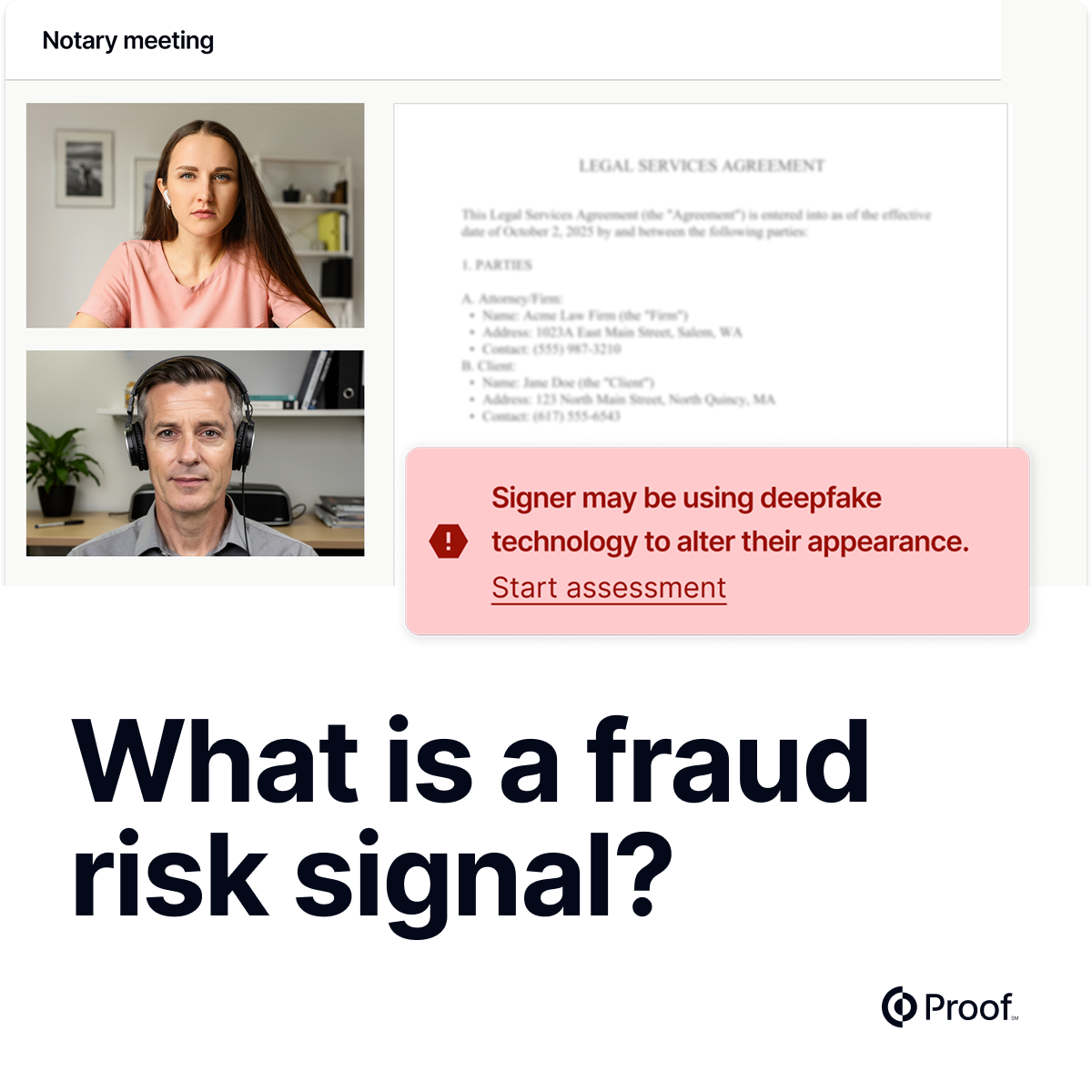
Deepfake attacks use AI-generated video or audio to impersonate a real person during a live verification session. Hiring teams, financial institutions, and notarization platforms have all encountered deepfake attempts. Liveness detection that relies on passive observation is no longer sufficient against current attack tools.
Synthetic identity fraud combines real and fabricated data to create identities that pass standard Know Your Customer (KYC) checks. The synthetic identity has a credit history, a Social Security number, and a plausible profile. It fails only when the underlying fabrication is detected, which standard document checks often miss.
Injection attacks bypass the camera entirely, feeding pre-recorded or AI-generated media directly into the verification pipeline. An organization that deploys liveness detection without also defending against injection attacks has closed one door and left another open.
These threats require layered defenses: document verification, biometric comparison, liveness detection, injection attack detection, behavioral risk scoring, and human review for high-risk sessions.
What organizations should prepare for next
The trajectory of digital identity points in a clear direction. Organizations that treat identity as infrastructure rather than a compliance checkbox will be better positioned across all of the following shifts.
Passwordless authentication will become the default. The transition is already underway at enterprise scale. Organizations should audit their account recovery workflows now, because that is where passwordless systems create new exposure.
Identity verification will extend across the transaction lifecycle. Point-in-time verification at onboarding is table stakes. High-value workflows, including wire authorizations, account changes, loan closings, and power of attorney documents, require identity confirmation at the moment of action, not just at account creation.
Cryptographic proof will separate defensible records from vulnerable ones. Digital signatures tied to verified identities create tamper-evident records that hold up in disputes. Organizations handling high-stakes documents should understand the difference between an electronic signature that captures a click and a cryptographically signed record that binds a verified identity to a specific action at a specific time.
Regulation will continue to expand. The floor is rising. Organizations that build identity infrastructure to meet today's requirements will need to update it. Organizations that build to a higher standard now will have less to retrofit later.
Personalization will follow verified identity. As identity verification becomes more reliable, organizations will use verified identity data to deliver more accurate, personalized experiences. The shift from managing identities to using them as a foundation for trusted engagement is already underway in financial services and healthcare.
How Proof approaches digital identity
While companies used to focus on managing digital identities, more companies will begin using digital identities to deliver more accurate personalized experiences, to differentiate themselves from competitors.
Our mission with Proof is to set the gold standard for digital identity verification. Welcome to the future of trust in the digital world.
Learn more at proof.com.
































.jpg)




















































.jpg)