Estate planning

Using Proof for estate planning documents

Proof is a technology platform for remote electronic execution of legal documents. This page explains what our platform does, what it doesn't do, and what you need to figure out with your own legal counsel before we talk.
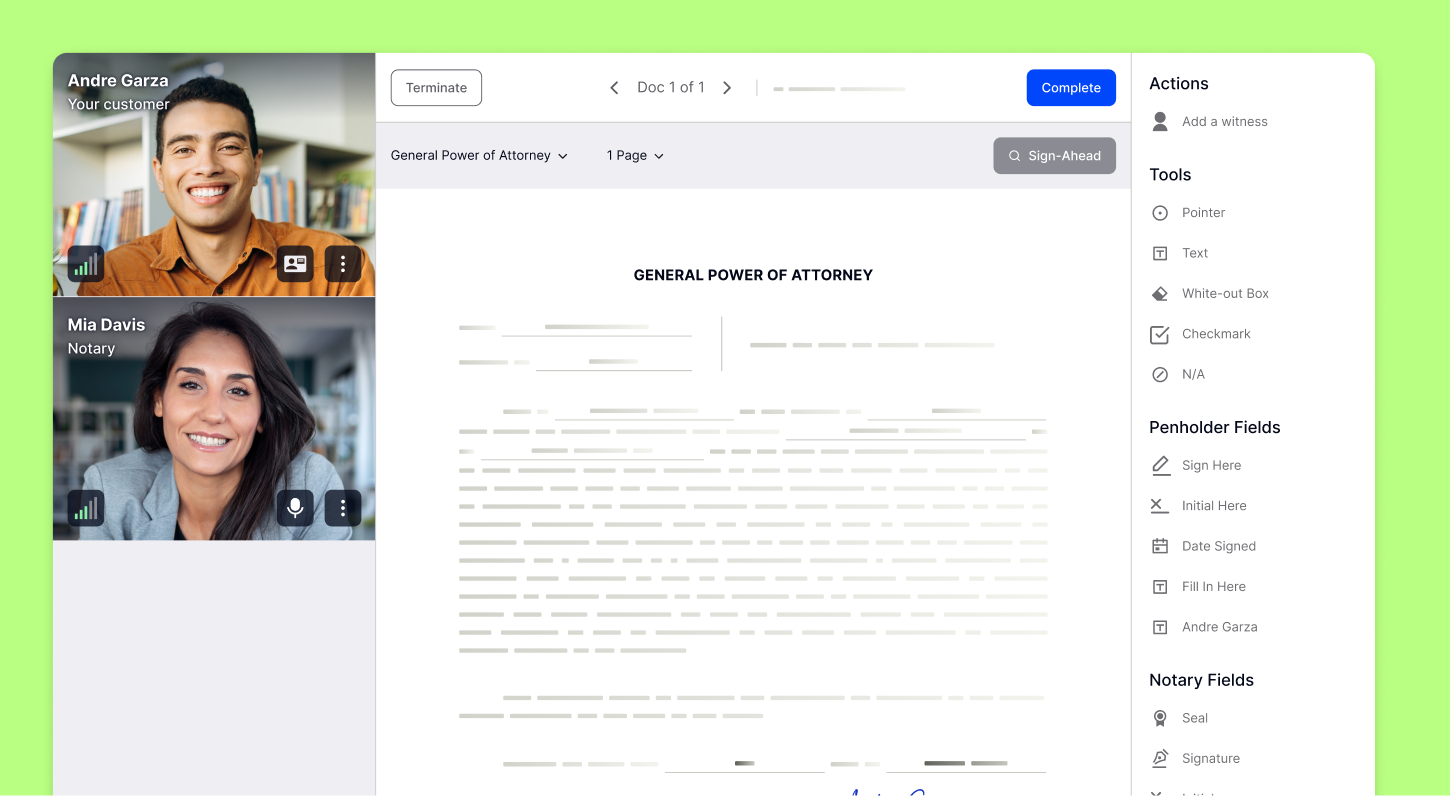
A live Proof Remote Online Notarization session executing a General Power of Attorney: signer and notary on video, with notary seal and signature fields.

We are not a law firm and do not provide legal advice. Proof does not guarantee that any document executed on our platform will be accepted by a court, probate authority, or other third party. Before engaging our sales team, you must work through the questions below with your own legal counsel.

Step 1 — Before you reach out

Orient yourself first

In order to assess if Proof is the right fit, your legal team needs to...

1

What documents are in your estate planning package?

Wills, trusts, pour-over wills, powers of attorney, and advance directives are not treated the same under state law. Different document types carry different execution requirements. Know what you're building before you call us.

2

Which states will your clients be signing from?

Proof's execution capabilities are available in most states, but legal requirements — and court acceptance of electronically executed documents — vary significantly by testator domicile and state of execution.

3

Do you intend to use a choice-of-law provision?

Some practitioners execute documents under a specific state's law regardless of where the testator lives. If you're considering this — for example, executing Nevada wills for signers located across multiple states — your legal counsel must evaluate and confirm this strategy. We don't recommend or endorse any specific approach.

Step 2 — Match to what we offer

What Proof supports — and what it doesn't

Once you've answered those three questions, use this section to assess whether what Proof offers fits your requirements. This is the menu — you need to choose from it.

What Proof supports
  • E-signature and Remote Online Notarization (RON) over video, with identity verification and a tamper-evident audit trail
  • Co-located witnesses — your client brings their own witnesses who are physically present during the session in the same room as the signer during the notary session
  • On-demand witnesses (1 or 2) — Proof provides witnesses during the live notary meeting
  • Remote witnesses as additional RON signers — for workflows where witness signatures themselves require notarization
  • On-demand notaries in 5 states (FL, VA, PA, TX, NV) serving transactions across all 50 states
  • ID review by on-demand witnesses, as required by certain states for specific document types
  • APIs to programmatically return documents to your system of record post-completion
What Proof does not do
  • Proof does not act as a qualified custodian. If your state requires custodianship of digital wills, you must arrange this separately.
  • Proof does not provide on-demand notarized witness signatures at scale. Workflows requiring this need to be discussed with our team before assuming it's supported.
  • Proof does not guarantee document acceptance by any court, probate registry, or authority.
  • Proof does not provide legal advice, interpret state laws, or tell you which choice-of-law provision is appropriate for your use case.

Witnessing workflows — how they work

Because witness requirements vary significantly by state and document type, confirm your legal requirements with counsel so our team can align you with the right workflow.

Witnesses without notarization

  • Co-located witnesses — your client brings their own witnesses who are physically present in the same room during the notary session.
  • On-demand witnesses — Proof provides 1 or 2 witnesses on-demand during the live notary session.

Witnesses with notarization required

  • Remote witnesses as RON signers — the witness is added as a separate RON signer, completes identity verification, and joins the live video session alongside the primary signer. Required for certain self-proving wills.
On the location of our notaries: Proof's on-demand notaries are based in FL, VA, PA, TX, and NV — and they serve transactions across all 50 states. Whether a notary in one state can notarize a document for a signer in another depends on choice-of-law provisions and interstate recognition rules your counsel must evaluate. The notary's state does not necessarily dictate which state's law governs the will.

Step 3 — Assess the fit

Is this a good fit for you?

Be honest about where you are. Customers who are still figuring out their legal framework end up costing both sides time.

Proof is likely a good fit if you…

  • Have already worked with legal counsel to identify which states and document types you intend to serve
  • Understand the execution requirements for those states and documents
  • Have a clear position on choice-of-law and custodianship
  • Are already doing this today with another vendor and want to switch
  • Are looking for a technology platform to execute a workflow you've already designed

Proof is not a good fit if you…

  • Are still in the research phase of determining where you can legally offer electronic estate planning
  • Are looking for us to guide the legal analysis of your use case
  • Haven't had an attorney review your platform's specific implementation
  • Don't yet know what documents you're executing, in which states, or under which law
  • Expect us to confirm that your documents will be accepted by courts or probate registries

Step 4 — Talk to sales

Ready to have a conversation?

If you've worked through everything above and believe Proof can support your use case, fill out the form below. Our team will review your responses and follow up — typically within 2 business days.

Contact our sales team

Tell us about your use case so we can have a productive first conversation.